
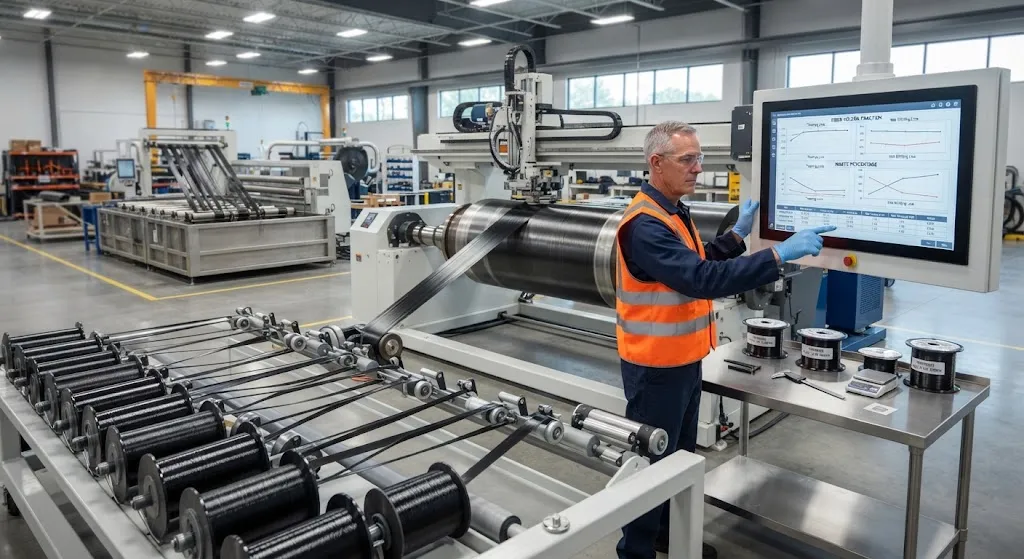
For cylindrical pressure vessels, hydrogen storage tanks, and rocket motor cases, the material form of the carbon fiber is as important as the fiber itself. A 40-70 liter Type IV hydrogen tank carries 50-65 percent of its raw material cost in carbon fiber, so the choice between wet wind
Introduction
For cylindrical pressure vessels, hydrogen storage tanks, and rocket motor cases, the material form of the carbon fiber is as important as the fiber itself. A 40-70 liter Type IV hydrogen tank carries 50-65 percent of its raw material cost in carbon fiber, so the choice between wet winding, towpreg, and prepreg winding determines both the structural efficiency of the laminate and the economics of the production line. Each process buys performance with a different currency: wet winding pays with void content and control, prepreg pays with material waste and storage cost, and towpreg balances the two by delivering dry-process cleanliness with near-prepreg fiber alignment.
This article quantifies the three routes — material cost per kilogram, fabrication waste, achievable fiber volume fraction, winding speed, and burst performance — and identifies where each process is the rational choice. The comparison matters beyond pressure hardware: the same decision logic governs drive shafts, flywheels, and solid rocket motor cases, where winding economics dominate total cost.
What Towpreg Is and How It Differs
Towpreg is a continuous carbon fiber tow pre-impregnated with a metered resin content, typically 30-40 percent by weight, and wound onto spools for direct use on winding machines. Unlike prepreg tape, which is slit from wide sheets and requires freezer storage below minus 18 degrees Celsius, towpreg is supplied as narrow slit tows on small spools with room-temperature shelf lives of weeks to months depending on the resin system. Unlike wet winding, which dips dry fiber through an open resin bath immediately before deposition, towpreg carries the resin already inside the tow, so the winding machine needs no resin bath, no metering rollers, and no solvent cleanup.
The intermediate character of towpreg shows up in every process number that matters: it has the fiber placement precision of prepreg with the low capital cost of wet winding. Kolon Industries in South Korea and a growing group of European and North American suppliers now produce towpreg in tow sizes from 12K to 60K, with epoxy, vinyl ester, and cyanate ester resin systems tailored to winding applications.
Cost Comparison: Material, Waste, and Equipment
The cost comparison must be done on total wound-part cost, because the cheapest material form is not always the cheapest finished vessel. The table below summarizes representative figures for a 45-liter Type III pressure vessel wound in production quantities:
| Cost and Process Item | Wet Winding | Towpreg Winding | Prepreg Tape Winding |
|---|---|---|---|
| Raw material cost (USD/kg equivalent) | 18-25 | 30-45 | 45-70 |
| Fabrication waste | 8-15% | 2-5% | 10-20% |
| Winding line capital cost | 150-400k USD | 250-500k USD | 800k-1.5M USD |
| Resin bath, mixing, cleanup labor | Ongoing | None | None |
| Freezer storage requirement | None | None | Required |
| Line speed (kg carbon deposited/hour) | 8-15 | 10-20 | 5-10 |
The waste numbers deserve attention. Wet winding loses material to resin bath drag-out, dripping, and the resin squeezed out at the end of each tow spool; prepreg tape loses material to slitting trim, backing paper, and freezer-life write-offs. Towpreg eliminates the resin bath entirely and ships with no backing paper, so scrap falls to the 2-5 percent range. For a tank containing 12 kilograms of carbon fiber at 40-60 dollars per kilogram, every percentage point of waste is real money across a production run of tens of thousands of tanks.
Process Metrics: Speed, Cleanliness, and Control
Process performance divides the three routes along lines that engineers planning a winding line care about:
- Fiber volume fraction: Wet winding typically achieves 55-60 percent, towpreg reaches 60-65 percent, and prepreg tape reaches 62-68 percent. The towpreg advantage over wet winding comes from the absence of the resin bath, which introduces uncontrolled resin pickup and trapped air.
- Void content: Wet-wound laminates commonly show 1-3 percent voids; towpreg and prepreg windings hold voids below 1 percent, which matters directly for burst pressure because every percent of voids reduces transverse strength and increases fatigue crack initiation sites.
- Winding speed: Towpreg winds faster than prepreg tape because it needs no backing paper peel-off and no tape heating, and faster than wet winding once the line is running because fiber tension control is more stable without resin bath drag.
- Cleanliness: Removing the resin bath eliminates volatile solvent emissions, resin cleanup shifts, and the fire-safety classification of the winding hall, which lowers facility qualification cost.
Reproducibility is the less obvious differentiator. Wet winding drift in resin content from bath viscosity changes means reel-to-reel weight variation of 2-4 percent; towpreg from a single lot holds resin content within 0.5-1.0 percent. For certificated pressure vessels where every tank is proof-tested and burst-tested, that repeatability shortens the qualification program and reduces scrap from out-of-tolerance parts.
Burst Performance and Structural Efficiency
Structural performance follows the process variables. Burst pressure in a filament-wound vessel scales with fiber volume fraction and fiber efficiency, so the same fiber wound as towpreg typically delivers 5-8 percent higher burst pressure than wet winding at the same fiber mass, while prepreg adds another 2-3 percent at the cost of significantly higher material price. Fatigue performance shows the same ordering: higher fiber volume fraction and lower void content shift the S-N curve, extending cycle life at the same operating pressure.
For rocket motor cases, where every kilogram of casing subtracts directly from payload, the choice shifts toward the higher-performance forms. Wet winding remains common for cases where cost dominates, but towpreg has become the material of choice for medium-pressure composite cases and for hydrogen tank liners where the 60-65 percent fiber volume fraction window is required without paying prepreg prices. Solid rocket motor manufacturers also favor towpreg because its narrow tow width gives precise dome geometry control and because no resin bath means no moisture pickup in the hygroscopic epoxy systems used in large cases.
Application Guidance
- Towpreg wins for Type III and Type IV hydrogen tanks, CNG tanks, composite rocket motor cases up to medium pressure, and any high-volume winding product where fiber volume fraction above 60 percent and void content below 1 percent are required at controlled cost.
- Wet winding still wins for very large tooling (driveshafts, large-diameter pipes, submarine and marine structures) where the cost of towpreg per kilogram is prohibitive, for one-off prototypes, and for low-pressure products where voids are tolerable.
- Prepreg tape wins for aerospace-grade high-pressure vessels and cases where maximum fiber volume fraction, certified traceability, and proven allowables justify 40-70 percent higher material cost, and where autoclave or oven cure is already part of the process.
Frequently Asked Questions
Is towpreg more expensive than wet winding per kilogram, and when does it pay back?
Towpreg costs roughly 30-80 percent more per kilogram than wet winding fiber, but the price gap closes on finished parts. Wet winding adds resin bath operation, lower fiber volume fraction, higher waste, and slower qualified throughput, and every missed percentage point of fiber volume fraction is structural performance not being paid for. For high-volume pressure vessel production the payback typically appears within the first 10-50 thousand tanks, and it appears immediately in process terms: no resin bath, no cleanup shifts, and void content below 1 percent.
Can towpreg be wound with the same machines as wet winding?
In most cases yes. The winding head, mandrel rotation, and payout eye are the same; what changes is the creel feed, which must handle spooled towpreg instead of dry tow, and the tension control, which no longer needs to compensate for resin bath drag. A wet winding line can be converted for towpreg with a modest investment in creel hardware and tension sensors, which is why many tank producers adopt towpreg as an incremental upgrade rather than a greenfield line.
How does prepreg winding justify its higher cost in aerospace pressure vessels?
Prepreg tape offers the highest fiber volume fraction, proven design allowables, and full process traceability from slit tape to cured structure, which is what aerospace qualification demands. When the vessel is part of a certificated flight system, the 40-70 percent material cost premium is small relative to system qualification cost, and autoclave curing is already required for other components. Where the same vessel could be cured out-of-autoclave and the performance requirement fits the towpreg window, towpreg delivers comparable structural efficiency at lower total cost.
Conclusion
For pressure vessels and rocket motor cases, the process-material choice is a cost-performance trade with three rational answers. Wet winding remains the low-capital route for large or low-pressure parts; prepreg tape remains the certified-performance route for aerospace; and towpreg occupies the widening middle — delivering 60-65 percent fiber volume fraction, void content below 1 percent, dry-process cleanliness, and waste under 5 percent at a material cost premium that high-volume production absorbs within tens of thousands of units. Hydrogen tank programs in particular have made towpreg a production standard because the raw-material-stakes are exactly where towpreg's economics shine.
For engineers qualifying wound hardware, the material form decision deserves the same rigor as fiber selection. Explore our towpreg and winding-grade carbon fiber range, or contact our engineering team to discuss material qualification and cost modeling for your vessel or rocket case program.
Part of topic
Related Articles
- Filament Wound FRP Pipe: Complete Guide
- Filament Wound Epoxy Tubes: Complete Guide
- Pultruded Carbon Fibre Rods: Cross-Sectional Properties and Standard Sizes
- Carbon Fiber Tube Fittings and Connectors: Joining Solutions for Structural Assemblies
- Carbon Fiber Plate Insert: Threaded Insert Design for Composite Structures
- Filament Wound Epoxy Tubing: Selection Guide for Industrial and Aerospace Applications
Interested in Our Products?
Contact our team for competitive pricing and technical specifications.
Get a QuoteRelated Products
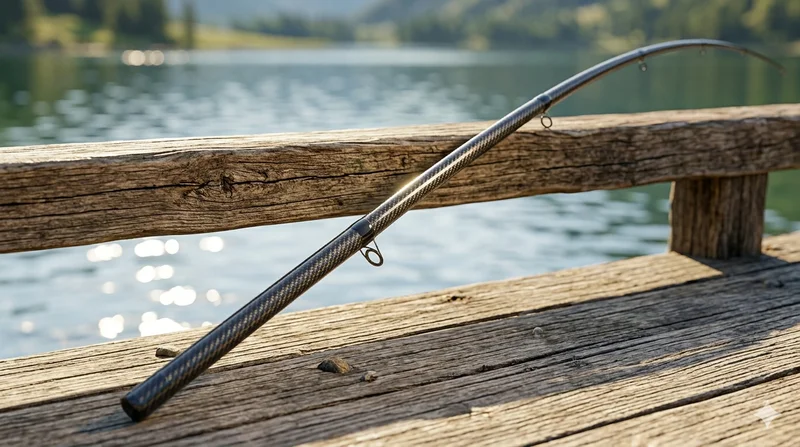
Carbon Fiber Fishing Rod Blank
High-quality carbon fiber fishing rod blank manufactured from multiple grades of Toray carbon fiber cloth. Available in a wide range of lengths, powers, and actions for freshwater and saltwater applications. Suitable for OEM rod building.
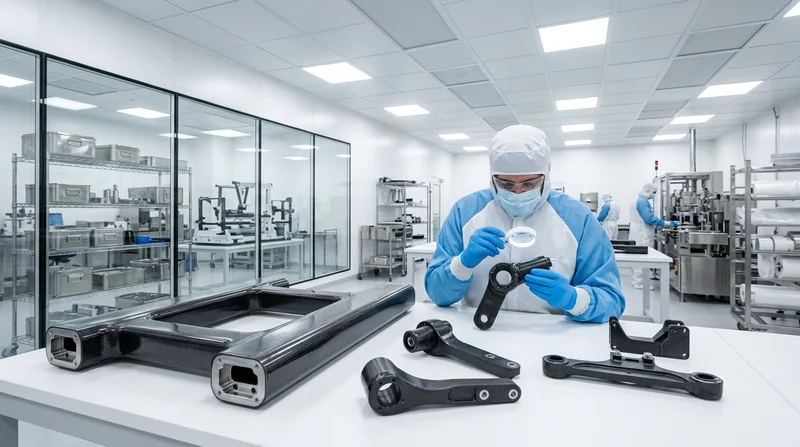
Custom Carbon Fiber Medical Device Components
Medical-grade carbon fiber components manufactured for imaging equipment, surgical instruments, and patient support systems. Carbon fiber's radiolucency (X-ray transparency) and high strength-to-weight ratio make it ideal for CT scanner beds, wheelchair frames, surgical robot arms, and MRI-compatible accessories. Biocompatible resin systems available.

Carbon Fiber Plate — 3K Twill T700 1.5mm
Thin 1.5mm carbon fiber plate with 3K twill weave surface. Lightweight and stiff, commonly used for covers, panels, drone bodies, and applications requiring a premium aesthetic appearance.

Square Carbon Fiber Tube — 3K Twill T700
Square cross-section carbon fiber tube manufactured with 3K twill weave for torsional strength. Preferred for structural frames, trusses, and support columns where rectangular geometry offers design flexibility.
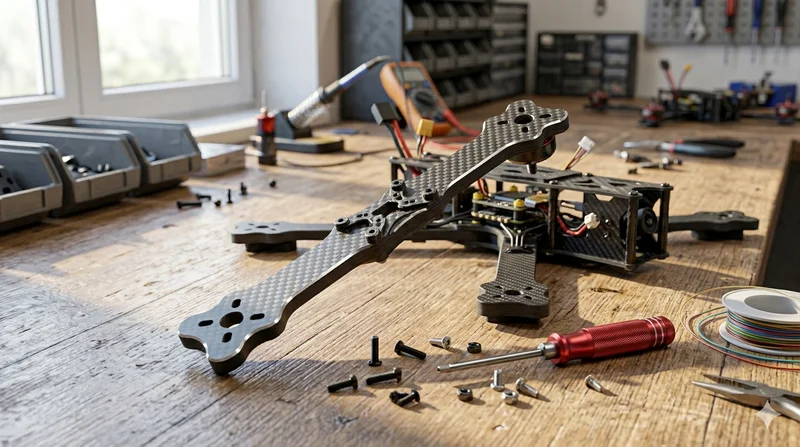
Carbon Fiber Drone Arm
Precision-molded carbon fiber drone arm combining unidirectional fiber for stiffness and woven layers for torsional strength. Designed for FPV, photography, and industrial drone platforms. Each arm is CNC-machined to exact specifications.