
Automotive mass production tolerates very few seconds per part beyond the cycle time of the line, and for structural carbon fiber that rule has historically been the bottleneck. Conventional RTM cures in 10-60 minutes, which suits low-volume sports cars but disqualifies it for B-segment
Introduction
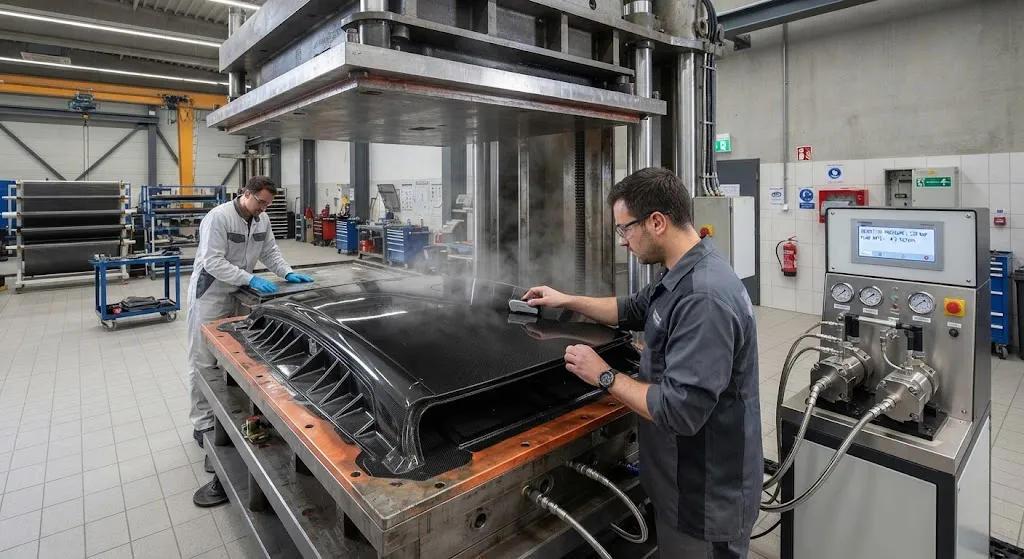
Automotive mass production tolerates very few seconds per part beyond the cycle time of the line, and for structural carbon fiber that rule has historically been the bottleneck. Conventional RTM cures in 10-60 minutes, which suits low-volume sports cars but disqualifies it for B-segment platforms running at 30-60 jobs per hour. High-pressure RTM closes the gap by changing the physics of injection: resin is delivered at 80-160 bar into a closed, heated cavity, wetting out the fiber preform in seconds and curing in minutes.
The technology has matured from motorsport body panels to roof modules, floor panels, and structural cross members that carry the visible-carbon signature buyers pay for. This article walks through the process, the resin chemistry, the tooling, and the surface-quality problem, with representative production data throughout, so engineers can evaluate HP-RTM against their own cycle-time and cosmetic targets.
Why Pressure Is the Differentiator
Classic RTM relies on resin flowing through the fiber preform under 1-10 bar of injection pressure, limited by the resin's viscosity and the permeability of the fiber bed. Flow fills the cavity in minutes, but the low pressure leaves micro-voids behind, especially in complex geometries with long flow paths. HP-RTM raises the stakes on three fronts: higher pressure pushes resin through the preform faster and more completely; the closed cavity holds pressure during cure, squeezing out entrapped air; and the higher flow rate reduces the time available for resin to gel before the cavity is full.
The numbers show the scale of the change. A typical HP-RTM cycle for an automotive roof module runs 100-160 bar injection pressure, a 40-90 second fill, a 90-180 second cure at 120-150 degrees Celsius, and a total cycle of 2.5-4 minutes. Fiber volume fractions land at 55-62 percent, up from 45-55 percent in conventional RTM, and void content drops below 1 percent, which is the threshold where structural allowables stop degrading. These are the process numbers that make HP-RTM the technology of choice for visible structural carbon fiber in production vehicles.
The Resin Side: Fast-Cure Systems and Their Limits
Cycle time in HP-RTM is set by the resin system. The workhorses are fast-cure epoxy systems formulated with accelerated hardener packages and reactivities tuned to gel in 30-90 seconds at mold temperature, then achieve demoldable glass transition temperatures in 2-5 minutes of cure. Two-component metering equipment mixes and injects at the point of use, so the pot life problem — which limits conventional RTM to slower resin systems — largely disappears.
Polyurethane and fast-cure vinyl ester systems hold niche positions, but epoxy dominates because of its balanced viscosity, mechanical performance, and surface behavior. The trade-off is process temperature: fast-cure epoxies need mold temperatures of 120-160 degrees Celsius, which requires heated tooling, thermal management, and careful handling of cure exotherm in thick sections. Higher reactivity also narrows the injection window, so process control — resin temperature, injection speed, and cavity temperature — is not a quality option but a precondition.
Class-A Surface Quality: the Visible-Carbon Problem
Producing a structural part with HP-RTM is one thing; producing a visible one is another. A Class-A carbon fiber surface is defined by three measurable attributes: surface waviness below about 10 micrometers over 10 millimeter wavelengths, fiber pattern fidelity (the weave or unidirectional image must stay crisp on the surface), and zero porosity reaching the surface layer — a single pinhole ruins a clearcoat finish.
Three techniques close the gap. In-mold coating (IMC) injects a thin clear or colored coating layer into the closed cavity after fiber wet-out but before full gelation, burying surface voids under a controlled resin-rich layer. Gel-coating of the tool surface before preform loading achieves a similar result for lower-value parts. And surface-film technology bonds a resin-rich interlayer into the laminate stack, protecting the outermost plies from fiber wash and pinholing during injection. The production combination that consistently delivers Class-A is vacuum-assisted cavity venting combined with IMC — the vacuum removes entrapped air at the surface and the IMC layer seals the structure.
Cycle-Time Architecture and Comparison Data
The table below positions HP-RTM against the alternatives a design engineer might evaluate for a visible automotive carbon fiber part:
| Process | Cycle Time (min) | Fiber Volume | Void Content | Surface Quality |
|---|---|---|---|---|
| Conventional RTM | 10-60 | 45-55% | 1-3% | Requires IMC or scarfing |
| HP-RTM | 2-5 | 55-62% | <1% | Class-A with IMC |
| Prepreg + autoclave | 60-180 | 60-65% | <0.5% | Class-A with surface layers |
| CF-SMC compression | 1-3 | 35-50% | 2-5% | Class-B typical |
Two readings fall out of the table. First, HP-RTM is the only non-autoclave process that combines sub-5-minute cycles with sub-1-percent voids — the combination structural certification wants. Second, Class-A is not free: achieving it requires tooling precision, vacuum venting, and an in-mold coating capability that roughly doubles the tooling and consumable budget of a structural-only part. Engineers should therefore ask not whether HP-RTM can deliver Class-A, but whether this part's surface requirement justifies the added tooling.
Tooling and Operation Essentials
- Press and injection machine: High-pressure metering units inject at 80-160 bar with flow control to 0.1 liter per minute; presses need 500-5000 tonnes depending on part size, with fast clamp close.
- Heated, vacuum-capable tooling: Steel or nickel-shell molds with oil or electric heating to 120-160 degrees Celsius and edge or full-cavity vacuum channels.
- Sealing and venting: Closed-cavity sealing holds injection pressure and vacuum; peripheral vents with timed closure eject trapped air without resin flash.
- Automated preform handling: Preforms are cut, stacked, and loaded in a parallel station so the press is never idle waiting for fiber.
- Resin temperature control: Resin and hardener are temperature-conditioned to a plus or minus 1 degree Celsius tolerance to keep the fast-cure kinetics repeatable.
- Part quality loops: In-process monitoring of injection pressure curves, mold temperature, and cycle count feeds the data trail required for structural certification.
Frequently Asked Questions
Can HP-RTM really hit a 2-minute cycle with Class-A surface?
Only with the full equipment stack. Resin systems exist that cure to demold in 90-150 seconds at 130-150 degrees Celsius, and injection plus IMC can fit in the same window, giving a 2.5-4 minute total cycle including handling. But Class-A on top of that requires vacuum venting, an in-mold coating step, and nickel-steel tooling with minimal surface defects. Production lines that run sub-3-minute cycles with visible-quality surfaces do exist and are typically molded on large high-clamp presses with automated preform loading adjacent to the press.
What causes pinholes and dry spots in HP-RTM parts, and how do I prevent them?
Pinholes come from entrapped air at the cavity surface, usually where the flow front converges last — the standard fix is vacuum-assisted venting plus slightly higher injection pressure to push air out through the vents. Dry spots come from race-tracking: resin flowing along the cavity edges faster than through the fiber bed, closing off the vent before the center wets out. Preventing them means designing the preform to control permeability, using flow-optimizing inlet and vent placement, and validating with a molded fill study before production tooling is cut.
How does HP-RTM cost compare with prepreg-autoclave for the same visible part?
HP-RTM wins on cycle time and therefore on unit cost: a 3-minute HP-RTM cycle versus 60-180 minutes in autoclave changes throughput by one to two orders of magnitude, and the shorter cycle dominates the cost equation for any production volume above a few hundred parts per year. The trade-offs are tooling cost and flexibility — high-pressure tooling is expensive and hard to modify, while autoclave tooling is cheaper and more adaptable. For visible structural parts at automotive volumes, HP-RTM is typically 30-50 percent cheaper per part; for prototypes and low series, prepreg-autoclave retains the edge.
Conclusion
High-pressure RTM is the process that makes visible structural carbon fiber realistic inside automotive cycle-time budgets. It compresses injection and cure into a 2-5 minute window through high injection pressure, closed-cavity molding, and fast-cure resin chemistry, while delivering 55-62 percent fiber volume fractions, sub-1-percent voids, and — with vacuum venting and in-mold coating — genuine Class-A surface quality. The technology is not simple: resin kinetics, tooling precision, and automated preform handling must all be engineered as one system. But the cycle-time and quality data position it as the mainstream route for production carbon fiber panels and structural components.
For engineers evaluating fast-cure composite processes for automotive programs, explore our carbon fiber fabrics and prepreg systems, or contact our application engineering team to discuss HP-RTM material selection, preform design, and qualification data for your part.
Part of topic
Related Articles
- How Are Carbon Fiber Parts Made: Complete Guide
- Filament Wound Tube: Complete Guide
- Filament Wound FRP Pipe: Complete Guide
- Filament Wound Epoxy Tubes: Complete Guide
- Pultruded Carbon Fibre Rods: Cross-Sectional Properties and Standard Sizes
- Carbon Fiber Tube Fittings and Connectors: Joining Solutions for Structural Assemblies
Interested in Our Products?
Contact our team for competitive pricing and technical specifications.
Get a QuoteRelated Products

Carbon Fiber Fishing Rod Blank
High-quality carbon fiber fishing rod blank manufactured from multiple grades of Toray carbon fiber cloth. Available in a wide range of lengths, powers, and actions for freshwater and saltwater applications. Suitable for OEM rod building.
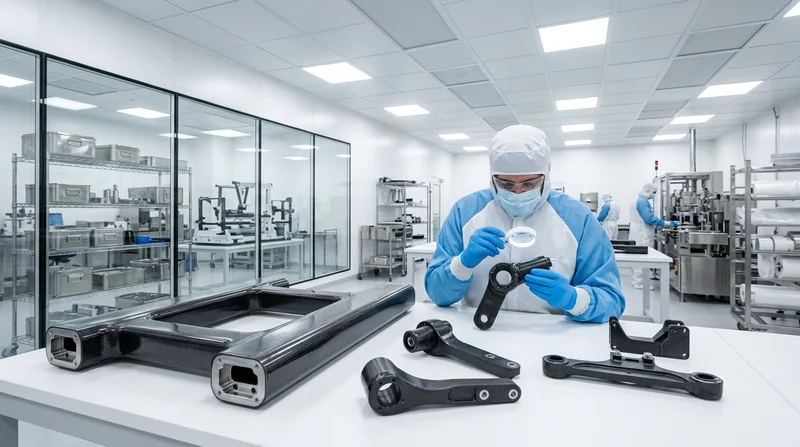
Custom Carbon Fiber Medical Device Components
Medical-grade carbon fiber components manufactured for imaging equipment, surgical instruments, and patient support systems. Carbon fiber's radiolucency (X-ray transparency) and high strength-to-weight ratio make it ideal for CT scanner beds, wheelchair frames, surgical robot arms, and MRI-compatible accessories. Biocompatible resin systems available.

Carbon Fiber Plate — 3K Twill T700 1.5mm
Thin 1.5mm carbon fiber plate with 3K twill weave surface. Lightweight and stiff, commonly used for covers, panels, drone bodies, and applications requiring a premium aesthetic appearance.
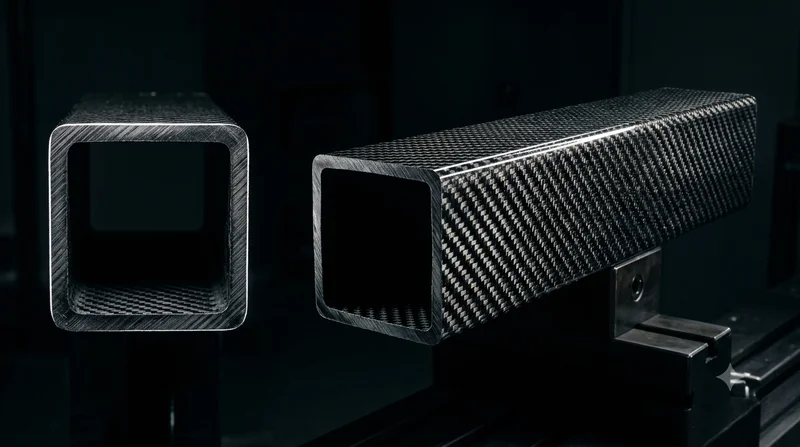
Square Carbon Fiber Tube — 3K Twill T700
Square cross-section carbon fiber tube manufactured with 3K twill weave for torsional strength. Preferred for structural frames, trusses, and support columns where rectangular geometry offers design flexibility.
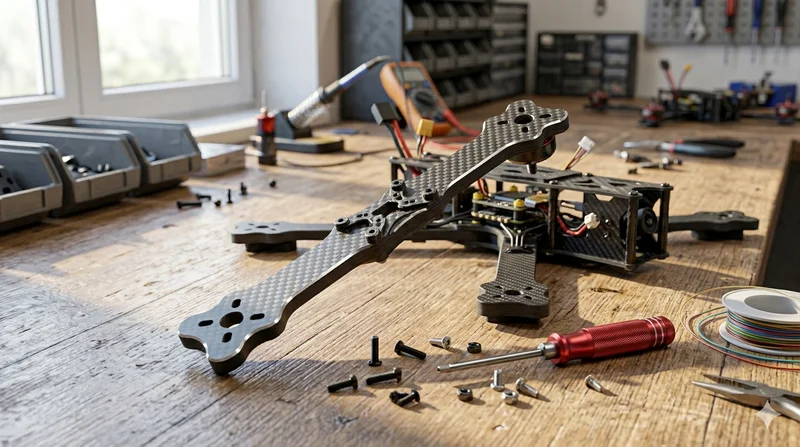
Carbon Fiber Drone Arm
Precision-molded carbon fiber drone arm combining unidirectional fiber for stiffness and woven layers for torsional strength. Designed for FPV, photography, and industrial drone platforms. Each arm is CNC-machined to exact specifications.