
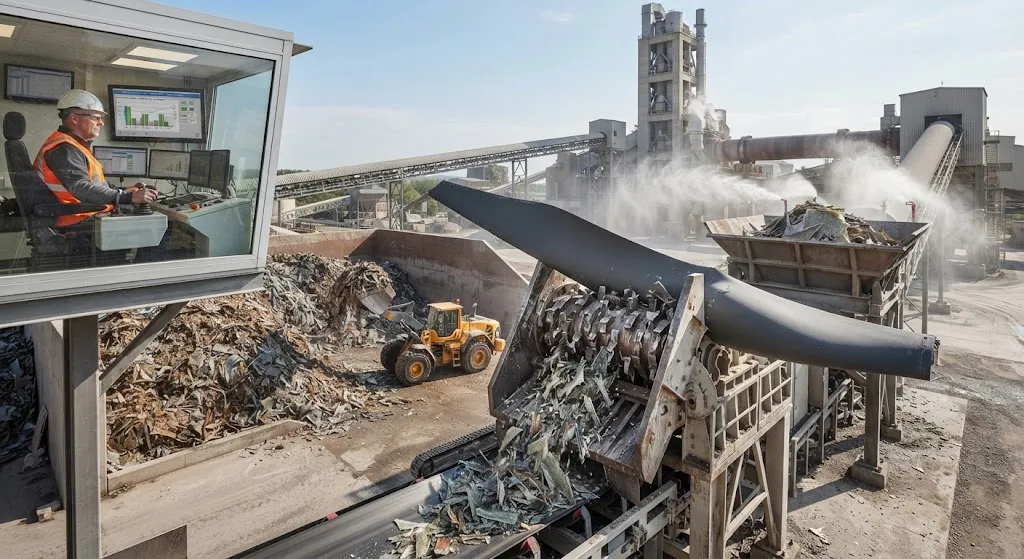
Cement co-processing is rapidly becoming the default destination for the largest and most difficult composite scrap streams in Europe. Wind turbine blades and boat hulls are the two most visible examples: both are too large to recycle through ordinary mechanical reprocessing, both have
Introduction
Cement co-processing is rapidly becoming the default destination for the largest and most difficult composite scrap streams in Europe. Wind turbine blades and boat hulls are the two most visible examples: both are too large to recycle through ordinary mechanical reprocessing, both have been largely landfilled until recently, and both are now covered by EU regulation that requires dramatically higher recycling rates. The logic of co-processing is simple and powerful: a cement kiln operates at temperatures around 1,450 degrees Celsius, consumes huge quantities of mineral raw material, and needs large amounts of fuel. Shredded composite scrap provides all three inputs.
This article explains how co-processing works technically, why initiatives such as the EuCIA-facilitated projects and the Finnish KiMuRa research programme are advancing it, and what the EU 2026/718 regulation means for blade owners and boatyards. We also compare the route against mechanical recycling, pyrolysis, and solvolysis, because the choice of end-of-life technology is increasingly a portfolio decision rather than a contest between two alternatives.
How Co-Processing Works
A modern cement plant is, in essence, a very large thermal-mineral reactor. Raw meal, a mixture of limestone, clay, and corrective minerals, is heated through a preheater tower into a rotary kiln that peaks around 1,450 degrees Celsius, producing clinker, the reactive intermediate of cement. Two properties make the kiln uniquely suited to composite waste. First, the resin fraction, which makes up roughly 30-40% of a cured composite by mass, has a calorific value comparable to coal and substitutes directly for fossil fuel. Second, the fiber fraction, predominantly glass in blades and hybrids in boats, contains the silica, alumina, calcium, and iron oxides that are precisely the minerals a kiln needs.
The co-processing route therefore works at three simultaneous levels:
- Fuel substitution: The epoxy, polyester, and vinylester resin burns in the kiln, replacing coal or petcoke and lowering the plant's fossil fuel bill.
- Raw material substitution: Glass fiber contributes silica and calcium, carbon fiber contributes carbon as energy and residual alumina as mineral, displacing a portion of virgin raw meal.
- CO2 reduction per tonne: Because the waste replaces both fossil fuel and clinker raw material, processing roughly one tonne of composite scrap avoids about one tonne of CO2 emissions compared with landfilling plus conventional fuel.
In practice the waste must be prepared before it can enter the kiln. Blades are cut with diamond or abrasive tools into sections, shredded to a particle size of typically 30-80 millimeters, and blended to keep the fuel and mineral chemistry within the plant's process window. The prepared refuse-derived fraction is then dosed into the precalciner or main burner, where its energy is released and its mineral content is incorporated into the clinker chemistry.
Why the EU Mandate Is Accelerating the Route
The regulatory push behind co-processing comes from EU 2026/718, which from 30 June 2026 requires that at least 70% of wind turbine blade material be recycled after decommissioning. This was a decisive change for the wind industry because blades are the single largest composite waste stream by mass in Europe, and the mechanical recycling routes available today cannot absorb them at the required scale. The mandate effectively forced a portfolio of solutions: reuse and repurposing where possible, co-processing as the scalable safety net, and pyrolysis and solvolysis for the higher-value fiber recovery fractions.
Two institutional initiatives are central to making co-processing operational at scale. The first is the EuCIA-led collaboration, which works with cement industry bodies to develop the logistics, shredding standards, and chemical dosing guidance that let cement plants accept composite waste reliably. The second is the Finnish KiMuRa research programme, which studies the mineral side of the process, quantifying how glass and carbon fiber content in the raw meal affects clinker quality and how co-processed cement maintains its standard performance grades.
For boat owners and boatyards the situation is converging on similar terms. End-of-life vessels, particularly sailing yachts and fishing boats whose hulls are built from glass and carbon-reinforced polyester, are accumulating faster than mechanical recyclers can process. A growing number of European ports and dismantling yards now route dismantled hull sections into cement plants, and the same 70% recycling logic is being extended from turbines to boats through national implementation of EU waste targets.
Comparing the End-of-Life Routes
Co-processing is not the only recycling technology, and the industry is learning that the routes are complementary rather than competing. The table below compares the principal options for large composite streams:
| Route | Output | Scale | Maturity | Key Limitation |
|---|---|---|---|---|
| Cement co-processing | Energy + clinker minerals | Very high | Commercial | Fiber is not recovered |
| Mechanical recycling | Downcycled filler, short fiber | Medium | Commercial | Properties degrade sharply |
| Pyrolysis | Recovered carbon fiber | Medium | Semi-commercial | Fiber strength loss, cost |
| Solvolysis | Fiber + resin monomers | Low | Demonstration | Chemical handling, cost |
| Reuse and repurposing | New products | Low | Emerging | Limited by geometry |
The practical hierarchy that operators are converging on is: reuse where the geometry allows, mechanical recycling where the fiber quality requirement is low, co-processing as the scalable backbone that guarantees the 70% target is met this decade, and pyrolysis or solvolysis for the fraction where recovered fiber price justifies the higher process cost. Co-processing wins on scale and simplicity. Its limits are equally clear: the fiber is consumed as chemistry rather than recovered as material, so it is a recycling route in the regulatory sense but not a circular economy loop for fiber itself.
What This Means for the Value Chain
For composite manufacturers, blade producers, and boatyards, the rise of co-processing changes waste management from a compliance cost into a logistics and chemistry discipline. Shredding capacity, transport economics, and feedstock consistency become the operating levers, and plants that can deliver clean, consistent shredded scrap command better gate fees than those that dump whole blades at landfill prices.
For the carbon fiber supply chain specifically, the strategic implication is about grade allocation. High-value carbon fiber that can still be recovered with useful mechanical properties should be routed toward pyrolysis and solvolysis, while mixed, contaminated, or oversized carbon fiber waste flows naturally into co-processing. The EU mandate guarantees a rising baseline of co-processed tonnage through the end of the decade, which in turn stabilizes the business case for investing in the fiber-recovery technologies that sit above it in the value hierarchy.
Frequently Asked Questions
What is cement co-processing of composite waste?
Cement co-processing uses shredded composite scrap, such as wind blade and boat hull sections, as a substitute for both fossil fuel and mineral raw material in a cement kiln. The resin burns for energy while the glass and carbon fibers contribute silica, alumina, and calcium to the clinker chemistry, avoiding about one tonne of CO2 per tonne of waste processed.
Is co-processing considered recycling under EU regulation?
Yes. Under EU 2026/718, co-processing counts toward the 70% recycling rate required for decommissioned wind turbine blades from 30 June 2026, because the mineral fraction of the waste is genuinely incorporated into the final cement product rather than discarded.
Why can't composite blades be mechanically recycled instead?
Mechanical recycling of a 60-100 meter blade produces downcycled filler and short fiber with sharply degraded properties, and the logistics of cutting, transporting, and grinding such large parts make the route uneconomic at scale. Co-processing accepts the same parts after simple shredding and recovers their energy and mineral value at kiln scale.
Does co-processing recover carbon fiber?
No. Co-processing consumes the fiber as energy and mineral chemistry, so it does not return fiber to the market. Fiber-recovering routes such as pyrolysis and solvolysis are used for higher-value material, while co-processing serves as the scalable backbone for material that cannot be economically de-fibered.
Conclusion
Cement co-processing has moved from experimental niche to the default scalable route for the largest composite waste streams in Europe. It turns wind turbine blades and boat hulls into fuel and clinker minerals in a single industrial step, avoids roughly one tonne of CO2 per tonne of waste, and is the only proven technology with the capacity to absorb the volume that EU 2026/718 will push into recycling from 30 June 2026. The route does not recover fiber as material, which is why the value chain now treats co-processing as the backbone beneath pyrolysis, solvolysis, and reuse for the fractions where they make economic sense.
YongXian supplies carbon fiber products for wind energy, marine, aerospace, and industrial applications, and advises customers on material selection for repairability and end-of-life planning. Explore our carbon fiber product range or contact our team to discuss sustainable material specification for blade and marine programmes.
Part of topic
Related Articles
- Filament Wound FRP Pipe: Complete Guide
- Filament Wound Epoxy Tubes: Complete Guide
- Pultruded Carbon Fibre Rods: Cross-Sectional Properties and Standard Sizes
- Carbon Fiber Tube Fittings and Connectors: Joining Solutions for Structural Assemblies
- Carbon Fiber Plate Insert: Threaded Insert Design for Composite Structures
- Filament Wound Epoxy Tubing: Selection Guide for Industrial and Aerospace Applications
Interested in Our Products?
Contact our team for competitive pricing and technical specifications.
Get a QuoteRelated Products
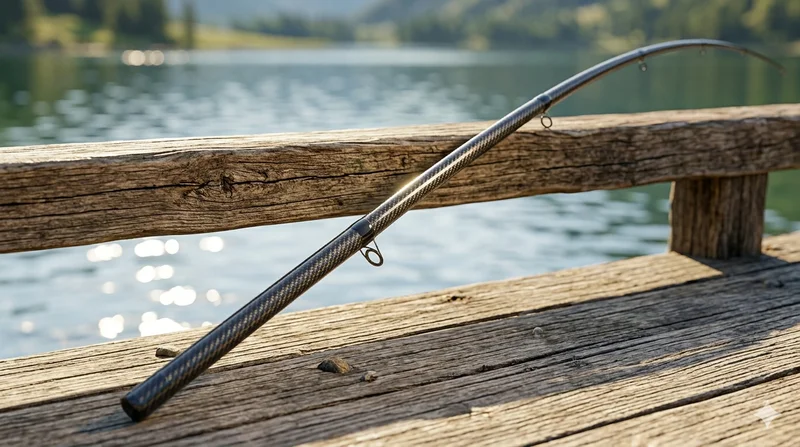
Carbon Fiber Fishing Rod Blank
High-quality carbon fiber fishing rod blank manufactured from multiple grades of Toray carbon fiber cloth. Available in a wide range of lengths, powers, and actions for freshwater and saltwater applications. Suitable for OEM rod building.
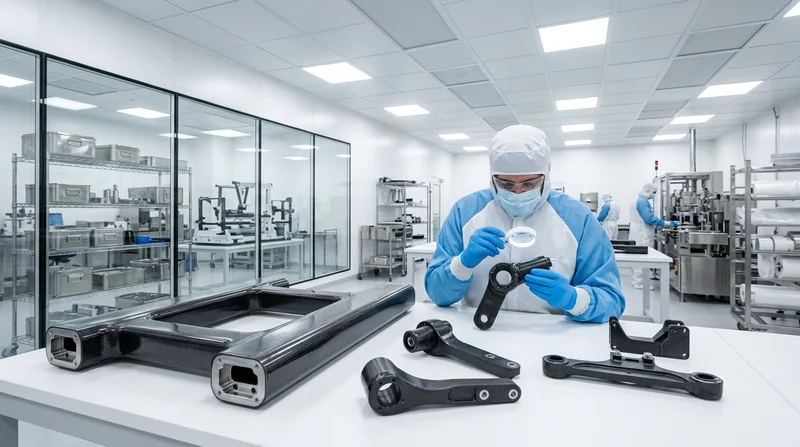
Custom Carbon Fiber Medical Device Components
Medical-grade carbon fiber components manufactured for imaging equipment, surgical instruments, and patient support systems. Carbon fiber's radiolucency (X-ray transparency) and high strength-to-weight ratio make it ideal for CT scanner beds, wheelchair frames, surgical robot arms, and MRI-compatible accessories. Biocompatible resin systems available.

Carbon Fiber Plate — 3K Twill T700 1.5mm
Thin 1.5mm carbon fiber plate with 3K twill weave surface. Lightweight and stiff, commonly used for covers, panels, drone bodies, and applications requiring a premium aesthetic appearance.

Square Carbon Fiber Tube — 3K Twill T700
Square cross-section carbon fiber tube manufactured with 3K twill weave for torsional strength. Preferred for structural frames, trusses, and support columns where rectangular geometry offers design flexibility.
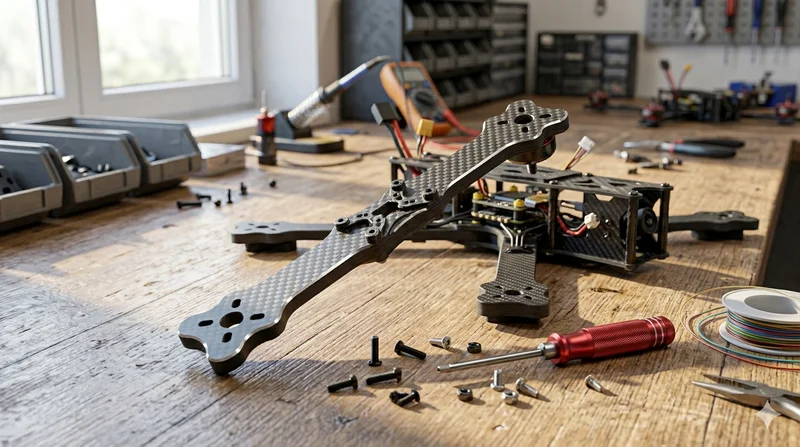
Carbon Fiber Drone Arm
Precision-molded carbon fiber drone arm combining unidirectional fiber for stiffness and woven layers for torsional strength. Designed for FPV, photography, and industrial drone platforms. Each arm is CNC-machined to exact specifications.