
Uzbekistan sits at an inflection point for advanced materials. For three decades the country built its industrial identity around raw cotton and natural gas exports, but government policy has shifted decisively toward domestic value addition: textiles are now processed locally rather th
Introduction
Uzbekistan sits at an inflection point for advanced materials. For three decades the country built its industrial identity around raw cotton and natural gas exports, but government policy has shifted decisively toward domestic value addition: textiles are now processed locally rather than shipped as fiber, and a pipeline of gas chemical and infrastructure mega-projects is creating demand for engineered materials that barely existed in the Central Asian market a decade ago. Carbon fiber products — from lightweight composite cylinders to high-speed textile machine parts — are entering this market through a narrow set of applications, and each one is growing for a different reason.
This article maps the Uzbekistan carbon fiber market for 2026. It looks at the textile industry, where the cotton-to-garment transition turns weaving and spinning equipment into a growth segment; the hydrocarbon sector, where CNG vehicle conversion and gas processing plants create demand for pressure vessels and corrosion-resistant composites; and the construction and mining programs that are beginning to adopt composite reinforcement. It closes with the early aerospace and drone activity that, although still small, signals where the market is heading.
The Textile Industry: From Cotton Fiber to Carbon Fiber
Uzbekistan remains one of the world's largest cotton producers, harvesting roughly one million tons of seed cotton per year, but the defining economic policy of the past decade has been to process that cotton domestically. The government ended cotton export bans gradually and pushed the industry from raw fiber toward finished garments, knitwear and home textiles. Textile exports have grown steadily and are expected to exceed three billion US dollars per year through 2026, with much of the output routed to European and Russian buyers who increasingly demand certified, technically advanced production lines.
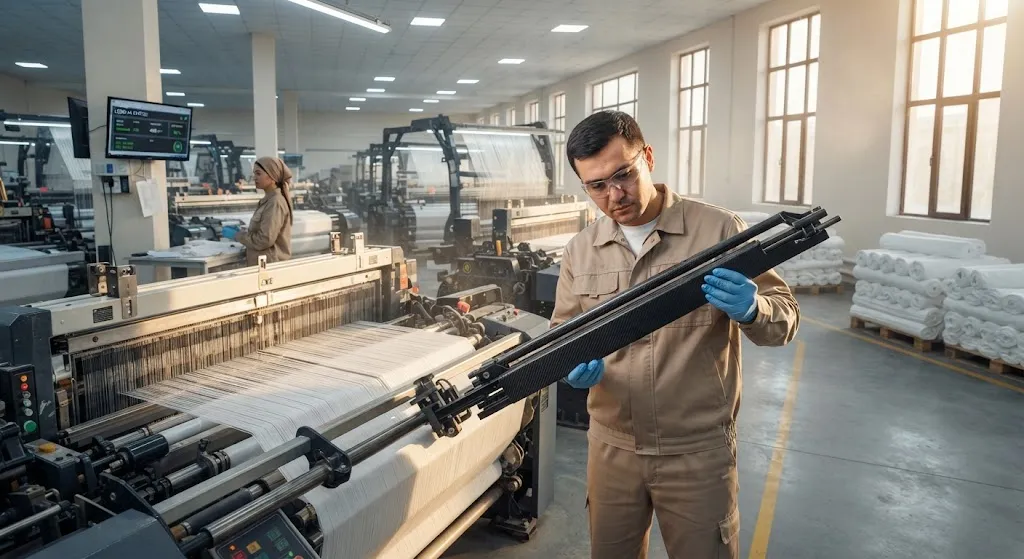
This industrialization has a direct carbon fiber consequence: modern weaving, knitting and spinning machinery uses carbon fiber in the components that move fastest and must stay stiff. Rapier heads, heald frames, guide rollers and loom parts made from carbon reinforced composites endure repeated high-speed cycles while keeping inertia low and dimensional accuracy high. A weaving plant that upgrades from older steel-based machinery to carbon composite components can run at higher pick rates with less vibration and fewer machine stops, which matters in a country where labor productivity in textiles is still converging with international benchmarks. Technical textiles — geotextiles, filter media and industrial fabrics — add another layer of demand, because the machines that produce them are the same high-precision platforms first equipped with composite parts.
Hydrocarbons: CNG Cylinders and Corrosion-Resistant Composites
Natural gas is Uzbekistan's largest export earner after gold, with annual production in the range of 50 billion cubic meters and a well-developed domestic pipeline network. Two carbon fiber applications follow directly from this position. The first is composite natural gas vehicle cylinders: compressed natural gas is the dominant alternative fuel in Uzbekistan, and the conversion of taxis, buses and commercial fleets from gasoline to CNG is an ongoing government-supported program. Type 3 and Type 4 composite cylinders, with aluminum or plastic liners wrapped in carbon fiber, deliver the weight savings and fatigue life that steel cylinders cannot match at 200 bar service pressure — a critical factor in a market where every kilogram of payload affects commercial vehicle economics.
The second application is in gas processing and refining infrastructure. The Ustyurt gas chemical complex and the Uzbekistan GTL plant, built to convert natural gas into synthetic fuels, operate in highly corrosive environments where conventional steel piping requires frequent inspection and replacement. Carbon fiber reinforced polymer piping, gratings and structural profiles resist hydrogen sulfide corrosion, reduce maintenance cycles and lower installation weight in remote desert locations. As Uzbekistan's petrochemical ambitions expand through 2026, these niche composite products grow alongside the larger steel and concrete supply chains that still dominate procurement.
Construction, Mining and Infrastructure
Uzbekistan's infrastructure program is among the most active in Central Asia. The Tashkent metro is extending its network with new underground and overground sections, regional road and bridge projects are running in parallel, and the government is pursuing renewable energy capacity targets that have attracted international investors building solar and wind plants in the desert regions. Each of these programs creates a small but measurable demand for carbon fiber: CFRP rebar and strengthening systems for concrete structures in aggressive environments, composite bridge cables and stays for signature spans, and lightweight structural profiles for building facades and equipment enclosures.
Mining adds a second node of demand. Uzbekistan is a top-tier gold producer — the Navoi region's Muruntau deposit is one of the largest open-pit gold mines in the world — and the processing plants that serve it require resistant materials for aggressive slurry and chemical environments. Carbon fiber reinforced parts appear in pump components, inspection platforms and light-duty structural applications where corrosion resistance and weight reduction justify the higher material cost. None of these segments is large in volume terms, but together they establish the supply relationships and installation experience that a broader market will build on.
Emerging Aerospace and Drone Activity
The newest demand signal comes from aerospace and unmanned aircraft. Uzbekistan Airways operates a modern fleet that requires certified composite repair capability, and the country's technical universities have begun offering composite materials programs in cooperation with international partners. On the drone side, agricultural and logistics operators are testing locally assembled unmanned aircraft for cotton field monitoring and crop spraying — applications where carbon fiber airframes provide the stiffness-to-weight ratio a small aircraft needs to carry sensors and spray equipment over long working days. The volumes are still modest, but the trajectory matters: aerospace-grade carbon fiber, even in kilogram quantities, pulls in the certification, handling and quality-control practices that upgrade the entire domestic composite ecosystem.
Market Segments at a Glance
The table below summarizes the main demand segments of the Uzbekistan carbon fiber market and their near-term outlook.
| Segment | Carbon Fiber Applications | Growth Driver | 2026 Outlook |
|---|---|---|---|
| Textile machinery | Rapier heads, heald frames, guide rollers, loom parts | Cotton-to-garment industrialization | Steady growth, technical textile upgrades |
| Natural gas vehicles | Type 3 / Type 4 CNG cylinders | Fleet conversion program | Growth tied to fuel subsidies |
| Gas processing | CFRP piping, gratings, structural profiles | Ustyurt complex, GTL plant expansion | Niche but sustained |
| Construction | CFRP rebar, bridge stays, strengthening systems | Metro, road and renewable projects | Emerging, project-led |
| Aerospace and drones | MRO composite repairs, UAV airframes | Fleet modernization, drone adoption | Early stage, high growth potential |
What the table makes clear is that no single segment dominates. Uzbekistan's carbon fiber demand is a portfolio of niche applications, each tied to a different government program or industrial transition — which makes the market resilient but also means suppliers must serve several small segments rather than one large one.
Practical Considerations for Suppliers
For carbon fiber product suppliers evaluating Uzbekistan, three practical points matter:
- Project-based purchasing: the market buys through project procurement and state-linked tenders rather than open distribution, so relationships with engineering institutes and system integrators count for more than marketing reach.
- Regional logistics: most composite goods enter through Almaty, Kazakhstan, or direct rail connections from China and Europe, and lead times of four to eight weeks are normal.
- International certification: requirements are converging toward international standards as Uzbek companies export textiles and equipment to the EU, so ISO and material-data documentation is becoming a competitive requirement rather than an optional extra.
Frequently Asked Questions
Is there a large carbon fiber market in Uzbekistan today?
No — the Uzbek market is small but real. Demand is concentrated in niche applications: composite CNG cylinders for vehicle conversion, corrosion-resistant composite components for gas processing plants, carbon fiber parts for high-speed textile machinery, and early-stage construction and aerospace projects. Total volumes are far below those of China, Germany or Turkey, but the annual growth rates are higher because the base is starting from nearly zero. For a supplier, the Uzbek market is best treated as a portfolio of smaller project-driven opportunities rather than a volume market.
Why is carbon fiber used in textile machinery?
Textile machines operate at very high cycle rates — modern looms run at hundreds of picks per minute — and every moving component must combine low inertia with high stiffness and dimensional accuracy. Carbon fiber reinforced composites deliver these properties better than steel or aluminum: they are lighter, stiffer per unit weight, and damp vibration that accumulates at high speeds. In practice this translates to faster machine speeds, fewer stops, longer component life and more consistent fabric quality. For Uzbekistan's expanding textile industry, upgrading to composite-equipped machinery is a productivity investment that pays back through higher output per machine.
What role does the hydrocarbon sector play in Uzbekistan's composite demand?
Natural gas is a cornerstone of the Uzbek economy, and it creates two distinct carbon fiber applications. The first is CNG vehicle cylinders, driven by the country's policy of converting commercial fleets from gasoline to compressed natural gas. The second is corrosion-resistant composite piping, gratings and profiles for gas processing and petrochemical plants, where traditional steel suffers from hydrogen sulfide corrosion. Both applications buy directly from composite manufacturers or through system integrators, and both are expected to grow as gas production and processing capacity expand through 2026.
Conclusion
Uzbekistan's carbon fiber market for 2026 is defined by transition rather than scale. The cotton-to-garment industrialization is upgrading textile machinery with composite components, the gas-based economy is generating sustained demand for CNG cylinders and corrosion-resistant composite infrastructure, and construction, mining and early aerospace programs are laying the foundations of a broader market. None of these segments is large on its own, but together they make Uzbekistan one of the more interesting emerging markets in Central Asia for composite suppliers that can work through project procurement and deliver certified, documented products.
For manufacturers and distributors evaluating this market, the practical first steps are qualifying a local partner, preparing ISO-grade product documentation, and targeting the textile and gas vehicle segments where the demand is already visible. Explore our carbon fiber product range for industrial applications, or contact our export team to discuss supply options and logistics for Central Asian delivery.
Part of topic
Related Articles
Interested in Our Products?
Contact our team for competitive pricing and technical specifications.
Get a QuoteRelated Products

Carbon Fiber Fishing Rod Blank
High-quality carbon fiber fishing rod blank manufactured from multiple grades of Toray carbon fiber cloth. Available in a wide range of lengths, powers, and actions for freshwater and saltwater applications. Suitable for OEM rod building.

Carbon Fiber Plate — 3K Twill T700 3.0mm
Medium-thickness 3.0mm carbon fiber plate offering significantly higher load capacity while maintaining attractive 3K twill finish. Suitable for structural brackets, reinforcement plates, and load-bearing panels.

Custom Carbon Fiber Medical Device Components
Medical-grade carbon fiber components manufactured for imaging equipment, surgical instruments, and patient support systems. Carbon fiber's radiolucency (X-ray transparency) and high strength-to-weight ratio make it ideal for CT scanner beds, wheelchair frames, surgical robot arms, and MRI-compatible accessories. Biocompatible resin systems available.

Carbon Fiber Plate — 3K Twill T700 1.5mm
Thin 1.5mm carbon fiber plate with 3K twill weave surface. Lightweight and stiff, commonly used for covers, panels, drone bodies, and applications requiring a premium aesthetic appearance.

Square Carbon Fiber Tube — 3K Twill T700
Square cross-section carbon fiber tube manufactured with 3K twill weave for torsional strength. Preferred for structural frames, trusses, and support columns where rectangular geometry offers design flexibility.