
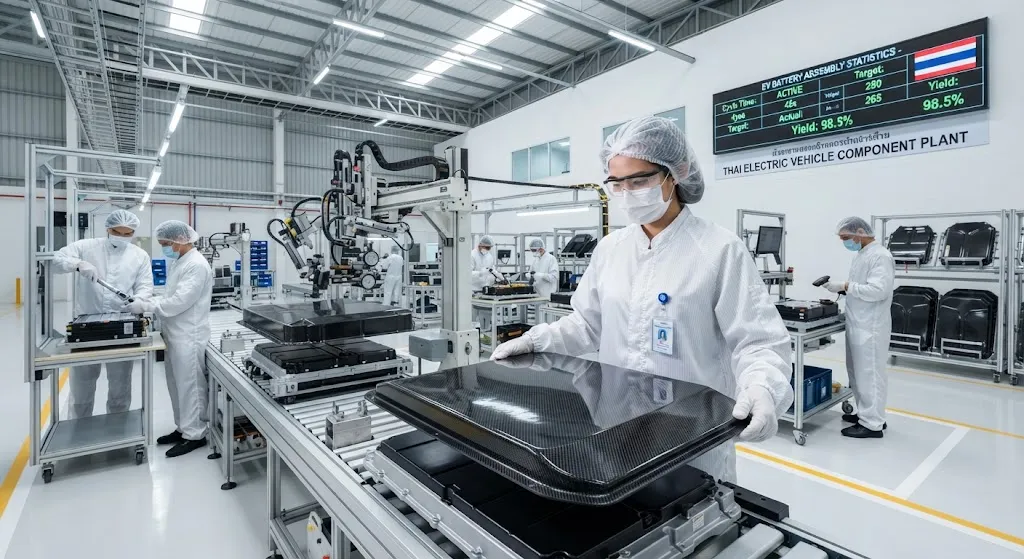
Thailand has spent the past decade repositioning itself from a low-cost manufacturing base into a mid-tier industrial hub for electric vehicles, electronics and premium consumer goods. The country already built the largest automobile production complex in Southeast Asia and the global c
Introduction
Thailand has spent the past decade repositioning itself from a low-cost manufacturing base into a mid-tier industrial hub for electric vehicles, electronics and premium consumer goods. The country already built the largest automobile production complex in Southeast Asia and the global center for hard disk drive manufacturing. Now, government incentives for EV assembly and continued investment in the Eastern Economic Corridor (EEC) are shifting the emphasis of Thai manufacturing toward lighter, higher-value structures — a shift that is slowly but steadily pulling carbon fiber composites into the supply chain.
For carbon fiber suppliers, fabric weavers and composite processors, Thailand matters as a demand pool that is still shallow but growing from three directions at once: automotive structural and battery components, electronics production equipment, and a premium sports industry that already knows how to work with carbon. This article maps the three demand pillars, compares Thailand with neighboring Southeast Asian markets, and outlines the practical entry considerations for suppliers.
Pillar One: The EV Automotive Hub
Thailand's automotive policy centers on the EV 3.0 and EV 3.5 incentive programs, under which manufacturers receive excise tax reductions and subsidy support for locally assembled battery EVs, with conditions tied to domestic component sourcing. The policy has worked: multiple Chinese and Japanese automakers have committed assembly plants in Thailand, and EV production volumes have grown rapidly from a small base.
Carbon fiber demand from this pillar is emerging in three areas:
- Battery and thermal components: Battery pack covers, lightweight enclosure panels and heat management structures for EV packs, where composite materials provide electrical insulation, corrosion resistance and mass savings against steel.
- Lightweight body and trim structures: Roof panels, seat frames and interior structural components for premium EV models, where differentiation and range pressure justify composite content.
- Performance vehicles and tuning: A tradition of motorsport and performance modification in Thailand continues to absorb carbon fiber hoods, spoilers and interior trim, keeping a steady demand for fabrics and prepregs.
Because local composite processors are fewer than in China or Vietnam, a large share of current carbon fiber demand is served by imported finished parts and semi-finished materials, which leaves room for suppliers who can provide technical support and stable lead times to OEM and tier-one programs.
Pillar Two: Electronics and Precision Manufacturing
Thailand is the world's largest production base for hard disk drives and a significant node for printed circuit board assembly, precision components and clean-room manufacturing. Much of this capacity is concentrated in the Eastern Economic Corridor, the special economic zone linking Chonburi, Rayong and Chachoengsao provinces, which offers tax privileges and infrastructure investment for high-technology industries.
Carbon fiber enters this sector indirectly but consistently:
- Production equipment components: Lightweight rigid arms and frames for automated handling and inspection equipment, where carbon fiber's low mass and high stiffness improve positioning speed and accuracy.
- Wafer and component handling: Electrostatic-discharge-safe carbon fiber trays, cassettes and carriers used in clean-room electronics assembly, replacing metal where antistatic and lightweight properties are both required.
- Test fixtures and tooling: Stable, dimensionally reliable tooling boards and fixtures that hold tolerances better than aluminum under temperature variation.
Demand here is smaller in volume than automotive but higher in value per kilogram, and it rewards suppliers who can deliver precise, documented materials rather than commodity fabrics.
Pillar Three: Premium Sports and Marine
Thailand's premium sports industry is the oldest carbon fiber user segment in the country. The kingdom is a recognized manufacturing base for bicycle frames, golf equipment, fishing rods and other sporting goods, supplying both global brands and regional distributors. Phuket and the Andaman coast additionally support a yacht building, refit and repair industry that has historically been one of the largest composite consumers in Southeast Asia.
The sports pillar keeps Thai composite demand alive between larger industrial cycles:
- Bicycle and triathlon equipment: Carbon fiber frames, forks and components manufactured under contract for international brands, benefiting from Thailand's established precision manufacturing workforce.
- Fishing rods and golf shafts: High-modulus prepregs and specialized rolling processes for premium rods and shafts, a niche where Thai factories have decades of experience.
- Yacht and marine composites: Hulls, decks and interior structures built with glass-carbon hybrids, maintaining steady consumption of fabrics, resins and core materials on the Andaman coast.
For suppliers, this pillar offers the most immediate entry point: existing factories already hold carbon fiber tooling, trained laminators and export logistics, so adding new material sources requires less qualification effort than in the automotive or electronics sectors.
Market Structure and Volume Estimates
Thailand's total carbon fiber consumption is modest by global standards, but the mix of end uses is distinctive. Estimates for the current market suggest the following distribution:
| End-Use Segment | Estimated Share | Growth Outlook |
|---|---|---|
| Premium sports equipment | 35-40% | Stable, export-driven |
| Automotive (EV and performance) | 20-25% | Fastest growing, policy-backed |
| Electronics and precision handling | 10-15% | Steady, high-value |
| Marine and yachting | 10-15% | Cyclical, tour-dependent |
| Other (construction, MRO, consumer) | 10-15% | Moderate |
Two structural facts define the market. First, Thailand has no significant domestic carbon fiber precursor or tow production, so all raw material is imported, which means pricing follows global markets and supply reliability is a deciding factor for buyers. Second, the country has a deep base of end-product manufacturers but a thinner layer of intermediate composite processors, creating both a gap and an opportunity for fabric weaving, cutting and preforming services.
Thailand in the Southeast Asian Context
Buyers and suppliers evaluating Southeast Asia should compare Thailand against its neighbors:
| Criterion | Thailand | Vietnam | Indonesia | Malaysia |
|---|---|---|---|---|
| EV assembly incentives | Mature (EV 3.0/3.5) | Developing | Developing | Limited |
| Electronics base | Strong (HDD, PCB) | Strong (assembly, consumer) | Moderate | Strong (semiconductors) |
| Sports equipment heritage | Strong | Emerging | Moderate | Moderate |
| Automotive industry size | Largest in region | Growing fast | Growing | Stable |
| Composite processor base | Thin | Growing | Thin | Moderate |
Vietnam has captured a larger share of new textile and consumer electronics assembly and is building sports equipment capacity, while Thailand remains the region's automotive heavyweight and keeps the deepest marine composites industry. Suppliers with a regional strategy typically treat Thailand as the anchor for automotive and marine demand, with Vietnam as the growth play for high-volume sports and consumer applications.
Frequently Asked Questions
Is there carbon fiber production in Thailand?
No large-scale domestic carbon fiber manufacturing exists in Thailand today. The country imports carbon fiber tow, fabrics and prepregs, primarily from Japan, China, Taiwan and South Korea. This import dependence is unlikely to change in the near term because building carbon fiber precursor and oxidation capacity requires enormous capital and a large enough domestic demand base to justify it. What Thailand does have is deep end-product manufacturing: bicycles, marine craft, automotive parts and electronics equipment assembled with imported composite materials.
How do Thailand's EV incentives affect carbon fiber demand?
The EV 3.5 program ties tax benefits to locally assembled EV production and progressive domestic content requirements. As production volumes grow, automakers look for weight reduction to maximize range, and premium models increasingly specify composite components — battery covers, lightweight trim and structural panels. The direct volume is still small, but the policy creates a structural shift that will compound: every new assembly line that opens in the EEC adds qualified capacity that eventually evaluates composite suppliers.
Which carbon fiber products have the strongest demand in Thailand?
High-modulus prepregs for premium sports equipment (fishing rods, golf shafts, bicycle frames) remain the most consistent demand. In automotive, intermediate-modulus fabrics and prepregs for exterior and structural parts are growing fastest. In electronics and light industry, electrostatic-discharge-safe molded carbon fiber components and precision tooling materials command the highest value per kilogram. Standard-modulus commodity fabrics and chopped fiber products serve a broad but thinner base of industrial applications.
What should a carbon fiber supplier know before entering the Thai market?
Entry requirements mirror those elsewhere in Asia but with sharper emphasis on three points: guaranteed lead times and local warehousing (buyers import everything and fear stockouts); technical support in the local language, especially for sports and marine processors with legacy methods; and certification paperwork for automotive and electronics customers, who audit suppliers against global quality standards. The Eastern Economic Corridor's import duty waivers for qualifying manufacturers are worth studying, since they change the effective price advantage of local supply chains.
Conclusion
Thailand's 2026 carbon fiber market is small in volume but structurally attractive. The EV assembly boom creates a policy-backed automotive demand that did not exist five years ago, the electronics belt in the Eastern Economic Corridor generates steady high-value consumption, and the premium sports and marine industries provide a mature, export-linked base. Because Thailand has no domestic fiber production and a thin intermediate processing layer, suppliers who combine reliable sourcing with localized support can enter through the sports pillar today while positioning for the automotive ramp.
YongXian supplies carbon fiber fabrics, prepregs, unidirectional tapes and composite materials to manufacturers across Asia. Explore our carbon fiber product range or contact our engineering team to discuss regional supply arrangements and material specifications for your Thailand-based programs.
Part of topic
Related Articles
Interested in Our Products?
Contact our team for competitive pricing and technical specifications.
Get a QuoteRelated Products

Carbon Fiber Fishing Rod Blank
High-quality carbon fiber fishing rod blank manufactured from multiple grades of Toray carbon fiber cloth. Available in a wide range of lengths, powers, and actions for freshwater and saltwater applications. Suitable for OEM rod building.

Carbon Fiber Plate — 3K Twill T700 3.0mm
Medium-thickness 3.0mm carbon fiber plate offering significantly higher load capacity while maintaining attractive 3K twill finish. Suitable for structural brackets, reinforcement plates, and load-bearing panels.
Custom Carbon Fiber Medical Device Components
Medical-grade carbon fiber components manufactured for imaging equipment, surgical instruments, and patient support systems. Carbon fiber's radiolucency (X-ray transparency) and high strength-to-weight ratio make it ideal for CT scanner beds, wheelchair frames, surgical robot arms, and MRI-compatible accessories. Biocompatible resin systems available.

Carbon Fiber Plate — 3K Twill T700 1.5mm
Thin 1.5mm carbon fiber plate with 3K twill weave surface. Lightweight and stiff, commonly used for covers, panels, drone bodies, and applications requiring a premium aesthetic appearance.

Square Carbon Fiber Tube — 3K Twill T700
Square cross-section carbon fiber tube manufactured with 3K twill weave for torsional strength. Preferred for structural frames, trusses, and support columns where rectangular geometry offers design flexibility.