
Spain is one of the most diversified carbon fiber consuming markets in Southern Europe, and in 2026 its growth is led by the wind energy value chain. The country combines large-scale onshore blade manufacturing, a mature installed wind fleet that is now being upgraded through blade exte
Introduction
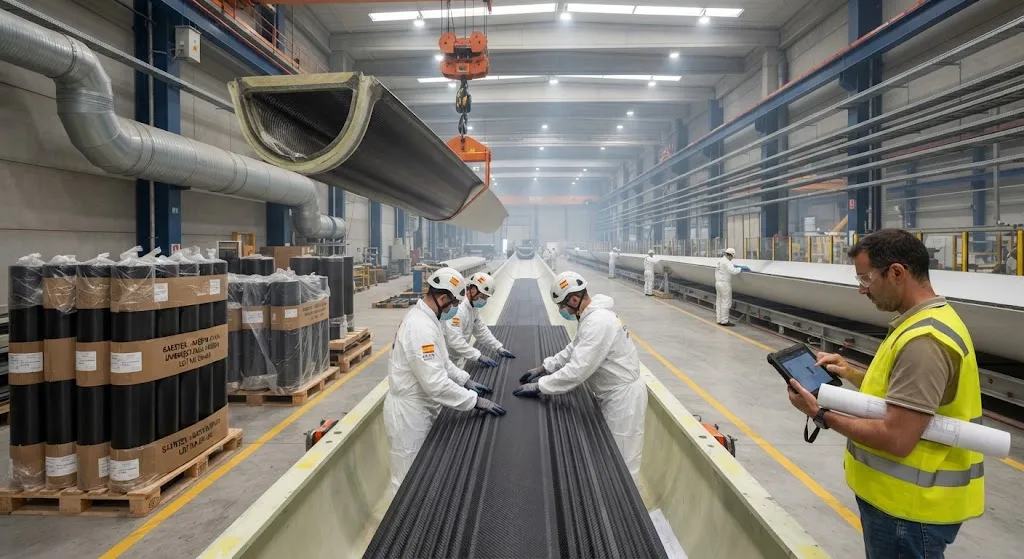
Spain is one of the most diversified carbon fiber consuming markets in Southern Europe, and in 2026 its growth is led by the wind energy value chain. The country combines large-scale onshore blade manufacturing, a mature installed wind fleet that is now being upgraded through blade extension retrofits, and an aerospace sector built around Airbus production sites in Getafe, Illescas, and Puerto Real. Each channel creates distinct demand: wind blades pull medium-modulus carbon fiber in fabric and pultruded form, retrofit programmes add a growing aftermarket stream, and aerospace requires qualified aerospace-grade prepreg.
This article examines how these three channels structure the Spanish market, quantifies the fiber demand associated with each, and identifies where the practical supply opportunities sit for carbon fiber producers. The unifying theme is medium-modulus fiber: wind blade scaling, blade tip extensions, and aerostructures all converge on the same 230-295 GPa modulus window that has become the workhorse of the industry.
Market Structure and Demand by Segment
The Spanish carbon fiber market is estimated to consume roughly 3,500-4,500 tonnes per year in 2026 when measured by end-use conversion, with the split below reflecting the relative weight of each channel. Wind energy is the largest segment, followed by aerospace, with automotive, sports equipment, and industrial applications making up the remainder:
| Segment | 2026 Demand Share | Growth Outlook | Primary Fiber Demand |
|---|---|---|---|
| Wind energy (blades) | 35-40% | 6-9% per year | Medium-modulus fabric, pultruded spar caps |
| Aerospace | 25-30% | 4-6% per year | Aerospace-grade prepreg, high-modulus tow |
| Retrofit & aftermarket | 8-12% | 15-20% per year | Blade extension kits, repair laminate |
| Automotive & motorsport | 8-10% | 5-7% per year | Standard-modulus fabric, woven tape |
| Industrial & other | 5-10% | 3-5% per year | Standard-modulus tow, recycled fiber |
Two structural features distinguish Spain from other European markets. First, blade manufacturing is concentrated in a handful of large plants serving global OEMs, which means volume demand is lumpy and tied to the production ramp of specific factories. Second, the retrofit segment is unusually developed because Spain's wind fleet is older on average than most European counterparts, making blade extension retrofits economically attractive without full repowering.
Wind Blade Manufacturing: The Medium-Modulus Anchor
Spain hosts a significant share of Europe's onshore wind blade production capacity. The most visible anchor is the Vestas blade plant at Daimiel in the Castilla-La Mancha region, which produces large onshore blades and has historically served both domestic and export turbine programmes. Alongside it, a network of established suppliers covers blade tooling, infusion consumables, and structural materials, creating a dense local ecosystem around blade production.
Two trends are reshaping the fiber demand profile of these plants:
- Blade length growth: Onshore blades now routinely reach 80-100 meters, and at these lengths the trailing-edge and spar-cap designs increasingly rely on carbon fiber to control mass, deflection, and fatigue loading. Medium-modulus fiber in pultruded spar cap form is the fastest-growing structural material input.
- Hybrid and carbon-spar designs: Rather than switching a blade entirely to carbon, manufacturers are adopting hybrid glass-carbon spar caps where carbon is placed only in the high-stress flange regions, reducing material cost while capturing most of the stiffness and mass benefit.
For suppliers, the practical entry point is 24K medium-modulus tow qualified for pultrusion and unidirectional fabric, plus the compatible resin systems. Volume is tied to plant production rates, so securing a blade OEM qualification is the critical step to meaningful, repeatable orders.
Blade Extension Retrofits: The Fast-Growing Aftermarket
Blade extension retrofits have become one of the fastest-growing demand channels in the Spanish market. The concept is straightforward: bolt-on tip extensions or full-length trailing-edge extensions add 10-15 meters of effective rotor diameter to an existing turbine, increasing annual energy production by 3-8% without touching the tower, nacelle, or generator. For Spain's aging onshore fleet, this is often the most economical route to more output short of repowering.
The retrofit channel creates a distinctive fiber demand profile. Extension kits are typically produced as prepreg or infusion-molded carbon-glass hybrid laminates, qualified against the load envelope of the original blade. Because retrofits are engineered per turbine model, demand is more fragmented than new blade production but higher margin:
- Prepreg laminates: Carbon-glass hybrid prepreg with tight thickness tolerance for bolt-on extension sections.
- Repair and bonding materials: Adhesive films, structural pastes, and unidirectional repair laminate for structural bonding of the extension to the blade shell.
- Qualified material traceability: Retrofit suppliers must document fiber pedigree against the turbine OEM's load case acceptance, favoring established fiber brands with published data sheets.
Several factors will sustain this channel through 2026-2030. Spain's wind fleet has a rising share of turbines beyond their twentieth year, extension retrofits extend asset life without permitting issues, and turbine OEMs themselves increasingly offer extension upgrades as catalog products. The retrofit aftermarket rewards suppliers who hold stock of qualified material and can respond to engineering-driven short lead times.
Aerospace: Airbus's Spanish Industrial Base
Aerospace remains the highest-value segment of the Spanish carbon fiber market. Airbus operates three principal composite production sites in Spain: Getafe, which manufactures fuselage panels and horizontal tail planes for single-aisle and A350 programmes; Illescas, which produces aircraft structures including fuselage sections; and Puerto Real, which specializes in ailerons, flaps, and control surfaces for the A320 and A350 families. These plants consume aerospace-grade carbon fiber prepreg in significant volumes and anchor a Tier 1 and Tier 2 supply chain across the country.
For carbon fiber suppliers the aerospace channel is the most demanding entry. Qualification against Airbus specification systems, stable mechanical property data across lots, and long certification cycles mean the channel is a strategic investment rather than a quick revenue line. However, once qualified, aerospace relationships produce stable, multi-year consumption that smooths the cyclicality of wind energy orders. The medium-modulus grades used in Spanish aerostructures overlap with wind blade grades, allowing suppliers to serve both channels from the same qualified fiber platform.
Supply Chain Opportunities
For carbon fiber producers evaluating Spain, the most practical path combines the wind and retrofit channels first, with aerospace as a longer-term qualification target. Wind blade plants and extension retrofitters both consume medium-modulus 24K fiber in fabric, pultruded, and prepreg forms, and both value supply security and consistent lot properties. The retrofit segment in particular offers faster time to first revenue for suppliers who can deliver qualified extension laminate quickly.
Practical entry steps include pre-qualifying 24K medium-modulus tow against pultrusion and infusion process windows, establishing stock holding agreements with Spanish blade and retrofit manufacturers, and building a data package that satisfies both wind OEM load-case acceptance and the initial documentation steps of Airbus qualification. Spain's port and industrial infrastructure, concentrated along the Mediterranean and Atlantic coasts, also supports cost-efficient logistics for fiber and fabric shipments into the local value chain.
Frequently Asked Questions
How large is the Spain carbon fiber market in 2026?
End-use estimates place Spanish carbon fiber consumption at roughly 3,500-4,500 tonnes per year in 2026. Wind energy is the largest segment at 35-40%, followed by aerospace at 25-30%, with retrofit, automotive, and industrial applications making up the remainder.
What is driving carbon fiber demand in Spanish wind blade manufacturing?
Two drivers: blade lengths growing to 80-100 meters, which push spar caps and trailing edges toward carbon for stiffness control, and hybrid glass-carbon spar designs that place carbon only in high-stress regions. The Vestas Daimiel plant and its supply network anchor the medium-modulus fiber demand.
How are blade extension retrofits changing the Spanish market?
Bolt-on tip extensions and trailing-edge extensions add 10-15 meters of rotor diameter, lifting annual energy production by 3-8% without repowering. Spain's older-than-average onshore fleet makes this the fastest-growing demand channel, with growth around 15-20% per year.
Which grades of carbon fiber do Spanish wind and aerospace customers need?
Wind blades and blade extensions use 24K medium-modulus fiber in pultruded spar cap, fabric, and prepreg forms. Aerospace customers consume aerospace-grade prepreg, typically in the same 230-295 GPa modulus window, so a qualified medium-modulus platform can serve both channels.
Conclusion
Spain's carbon fiber market in 2026 is defined by convergence on medium-modulus fiber across three channels: large-scale wind blade manufacturing anchored by the Vestas Daimiel plant, a fast-growing blade extension retrofit market driven by an aging onshore fleet, and Airbus's Spanish aerospace base. Suppliers who qualify medium-modulus 24K fiber in fabric, pultruded, and prepreg forms can serve blade, retrofit, and aerostructure demand from one material platform, with the retrofit segment offering the fastest route to first revenue.
YongXian supplies carbon fiber fabrics, prepregs, and reinforcement materials for wind energy, aerospace, and industrial customers worldwide. Explore our carbon fiber product range or contact our team to discuss material specifications for Spanish wind and retrofit programmes.
Part of topic
Related Articles
Interested in Our Products?
Contact our team for competitive pricing and technical specifications.
Get a QuoteRelated Products

Carbon Fiber Fishing Rod Blank
High-quality carbon fiber fishing rod blank manufactured from multiple grades of Toray carbon fiber cloth. Available in a wide range of lengths, powers, and actions for freshwater and saltwater applications. Suitable for OEM rod building.

Carbon Fiber Plate — 3K Twill T700 3.0mm
Medium-thickness 3.0mm carbon fiber plate offering significantly higher load capacity while maintaining attractive 3K twill finish. Suitable for structural brackets, reinforcement plates, and load-bearing panels.

Custom Carbon Fiber Medical Device Components
Medical-grade carbon fiber components manufactured for imaging equipment, surgical instruments, and patient support systems. Carbon fiber's radiolucency (X-ray transparency) and high strength-to-weight ratio make it ideal for CT scanner beds, wheelchair frames, surgical robot arms, and MRI-compatible accessories. Biocompatible resin systems available.

Carbon Fiber Plate — 3K Twill T700 1.5mm
Thin 1.5mm carbon fiber plate with 3K twill weave surface. Lightweight and stiff, commonly used for covers, panels, drone bodies, and applications requiring a premium aesthetic appearance.

Square Carbon Fiber Tube — 3K Twill T700
Square cross-section carbon fiber tube manufactured with 3K twill weave for torsional strength. Preferred for structural frames, trusses, and support columns where rectangular geometry offers design flexibility.