
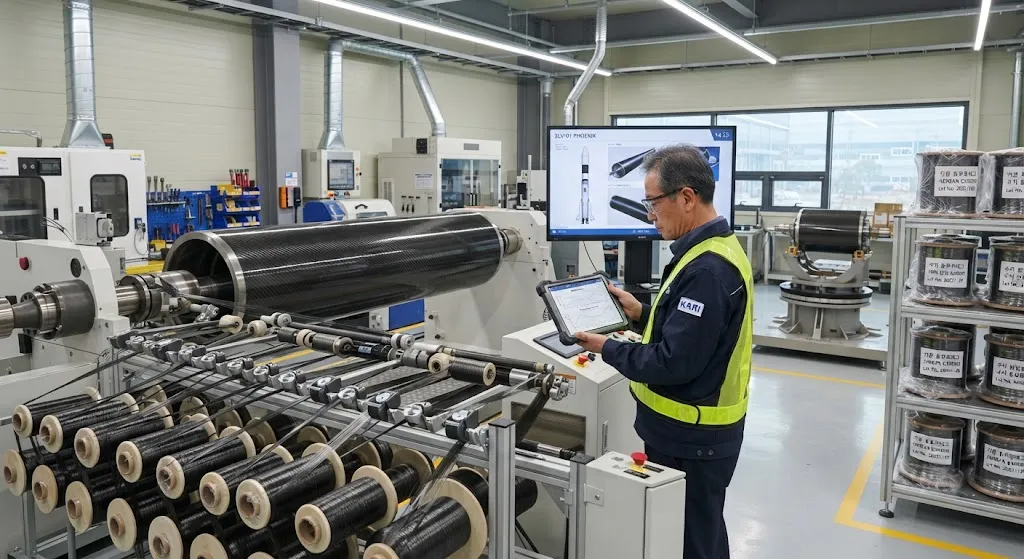
South Korea entered the carbon fiber race late and has since assembled one of the most complete domestic supply chains outside the traditional leaders. Hyosung Advanced Materials produces PAN-based carbon fiber under the Tansome brand; Kolon Industries supplies towpreg and aerospace-gra
Introduction
South Korea entered the carbon fiber race late and has since assembled one of the most complete domestic supply chains outside the traditional leaders. Hyosung Advanced Materials produces PAN-based carbon fiber under the Tansome brand; Kolon Industries supplies towpreg and aerospace-grade prepreg; and Kolon SpaceWorks, a rocket startup backed by the Kolon group, is building launch vehicles whose motor cases are filament-wound from composite tow. On the demand side, the KF-21 Boramae fighter and the LAH armed helicopter pull aerospace-grade material through domestic programs, while government localization policy systematically replaces imported fiber and semis with Korean product.
This article maps the industrial structure, the space and defense programs that drive demand, and the economics that make Korean composites competitive. For buyers and program planners, the trajectory matters: a country that manufactures its own fiber, its own towpreg, and its own launch vehicles is no longer just a user of carbon fiber.
From Tansome Fiber to Aerospace Grade
Hyosung Advanced Materials introduced Korea's first domestic carbon fiber in 2011 and has expanded Tansome capacity in stages, from an initial 2,000 tonnes per year to roughly 9,000 tonnes by the mid-2020s, with 12K and 24K tows serving industrial and aerospace segments. The Tansome line gave Korean fabricators a domestic source of PAN fiber and cut the import dependence that had been a structural weakness of the local industry — historically Korean aerospace, automotive, and sporting goods manufacturers bought fiber from Toray, Teijin, and Mitsubishi, paying premium prices and accepting long lead times.
Kolon Industries occupies the other critical slot: materials conversion. Kolon has built towpreg production aimed at filament winding — resin-impregnated tow wound on spools for motor cases, pressure vessels, and drive shafts — alongside prepreg for autoclave parts. Towpreg is the enabling material for the lightweight motor cases that the rocket programs below depend on, because it delivers the fiber volume fractions and void control of prepreg at winding economics closer to wet winding.
The two companies together cover the material spine of the industry: fiber from Hyosung, intermediate materials from Kolon, and an ecosystem of domestic winders, weavers, and part fabricators that has grown up around them.
Defense Programs Driving Aerospace-Grade Demand
Defense procurement is the largest single consumer of aerospace-grade composite structures in Korea. The table summarizes the programs that matter:
| Program | Builder / Operator | Composite Application | Status |
|---|---|---|---|
| KF-21 Boramae | Korea Aerospace Industries (KAI) | Wing skins, fuselage panels, empennage in CFRP | Series production, first deliveries 2024-2026 |
| LAH light armed helicopter | KAI | Composite fuselage, rotor components | In service since 2022 |
| FA-50 light fighter | KAI | Wing and tail structures, composite skin | Export production ongoing |
| KUH-1 Surion utility helicopter | KAI | Selected composite panels and fairings | In service |
KF-21 is the anchor program: a twin-engine fighter with CFRP wing skins and fuselage sections, built with a stated goal of reducing dependence on imported aerostructures. The Defense Acquisition Program Administration runs formal localization programs that require Korean suppliers to qualify fiber, prepreg, and detail parts against imported equivalents, which is exactly the kind of policy that lifts domestic material makers from commodity status to aerospace qualification. LAH demonstrates the same logic in rotary wing, with a composite fuselage that saved weight and fatigue life at the price of hard qualification work.
For material suppliers the defense channel matters twice over: it qualifies production systems, and it trains the workforce that later moves into commercial and space programs.
Space: Kolon SpaceWorks, Sebit, and the Hanbit Launcher Line
Korea's space sector matured in parallel: the Korea Aerospace Research Institute flew the Nuri (KSLV-II) launch vehicle to orbit in 2022 and again in 2023, after earlier failures, and the country's lunar orbiter Danuri reached the Moon the same year. Government ambition consolidated in 2024 with the creation of the Korea AeroSpace Administration, which sets a long-term target of a lunar landing in 2032. On the commercial side, Kolon SpaceWorks is the visible newcomer: a rocket startup, backed by the Kolon group, that is developing suborbital and orbital vehicles whose composite motor cases are wound from Kolon towpreg.
The company's development path is compressed. The Sebit suborbital test vehicle validated launch and recovery technology, including flights from the Alcantara spaceport in Brazil, chosen for its equatorial launch advantages. The orbital step is Hanbit-Nano, a small launch vehicle sized for nanosatellite-class payloads in the 50-100 kilogram range to low Earth orbit, with a maiden launch planned for late 2026. The motor cases are the composite story: filament-wound CFRP cases made from towpreg, giving the light structure that a small launcher needs to reach orbit with a meaningful payload fraction. For Korean suppliers, Hanbit is also a demonstration of domestic capability — fibers, towpreg, winding, and integration all within the country's borders.
The strategic pattern is the same as in defense: government anchor programs create qualification, commercial programs follow, and the composite supply chain captures value at every step.
The Localization Economics
Localization in Korean composites is driven by three numbers: the import share of aerospace-grade fiber, the government budget behind defense and space programs, and the cost gap that domestic qualification closes over time. Imported aerospace-grade prepreg carries premium pricing plus logistics and tariff overhead; the domestic alternative substitutes inventory for lead time and keeps qualification data inside the country. Government support — defense localization mandates, space budget growth, and the establishment of KASA — de-risks the private investment that makes domestic fiber and towpreg economically rational.
- Hyosung supplies domestic PAN fiber across industrial and aerospace grades, removing import dependence for fiber itself.
- Kolon supplies towpreg and prepreg, converting that fiber into winding and layup materials with domestic qualification.
- KAI and its supply chain build KF-21, LAH, and FA-50 structures from domestic materials, creating recurring aerospace-grade demand.
- Kolon SpaceWorks adds launch vehicles wound with domestic towpreg, extending the supply chain into space hardware.
- KASA anchors the ecosystem with lunar and orbital program targets that sustain qualification investment through the decade.
The result is one of the few markets where fiber, intermediate material, aircraft structure, and launch vehicle all sit inside a single national supply chain. For buyers, the practical consequence is a growing pool of qualified Korean sources for towpreg, prepreg, and wound structures — a genuine alternative to the established Japanese and European supply chains.
Frequently Asked Questions
What size launcher is Hanbit-Nano, and what does it carry?
Hanbit-Nano is a small orbital launch vehicle sized for nanosatellite-class payloads of roughly 50-100 kilograms to low Earth orbit, targeting commercial rideshare and dedicated smallsat missions. It follows the Sebit suborbital vehicle, which validated launch and recovery technology including flights from Alcantara in Brazil. A maiden launch of Hanbit-Nano is planned for late 2026, with composite motor cases wound from Kolon towpreg at the core of the vehicle structure.
How does Korean carbon fiber compare with Japanese fiber in aerospace applications?
Korean fiber has closed most of the gap in standard modulus and intermediate modulus grades used in aircraft structures. Hyosung's Tansome line spans 12K and 24K tows and serves both industrial and aerospace segments, and domestic qualification now supports KF-21 and LAH structure. Aerospace programs still demand certified traceability and proven allowables, which is a qualification hurdle rather than a material performance hurdle — the fiber itself meets mechanical targets, and the qualification cost is what localization policy exists to absorb.
Is Korea's defense sector a meaningful buyer of towpreg specifically?
Direct defense towpreg demand is modest, but defense programs create the aerospace-grade qualification pipeline that towpreg programs then use. The filament-wound motor case is the natural towpreg application, and Kolon SpaceWorks' rockets represent the most visible current demand. Defense aircraft programs keep the wider aerospace material chain qualified — qualification of the manufacturing base is what makes towpreg a strategic product, not just a cost line item.
Conclusion
South Korea has converted a late start into a structural advantage: domestic fiber, domestic towpreg, defense programs that demand aerospace qualification, and a launch vehicle line that puts the whole chain under one national supply system. The trajectory from Tansome fiber in 2011 to a towpreg-wound small launcher in 2026 is short by industry standards, and government policy — defense localization, the Korea AeroSpace Administration, the 2032 lunar target — keeps the qualification investments coming.
For engineers and buyers sourcing composite materials for space, defense, or high-performance industrial programs, Korean supply chains are now a qualified option worth evaluating. Explore our carbon fiber products, or contact our team to discuss material qualification and supply strategy for your program.
Part of topic
Related Articles
Interested in Our Products?
Contact our team for competitive pricing and technical specifications.
Get a QuoteRelated Products
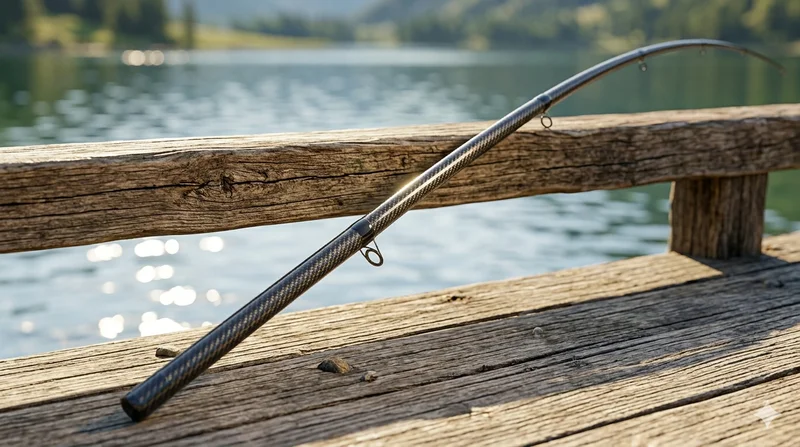
Carbon Fiber Fishing Rod Blank
High-quality carbon fiber fishing rod blank manufactured from multiple grades of Toray carbon fiber cloth. Available in a wide range of lengths, powers, and actions for freshwater and saltwater applications. Suitable for OEM rod building.

Carbon Fiber Plate — 3K Twill T700 3.0mm
Medium-thickness 3.0mm carbon fiber plate offering significantly higher load capacity while maintaining attractive 3K twill finish. Suitable for structural brackets, reinforcement plates, and load-bearing panels.
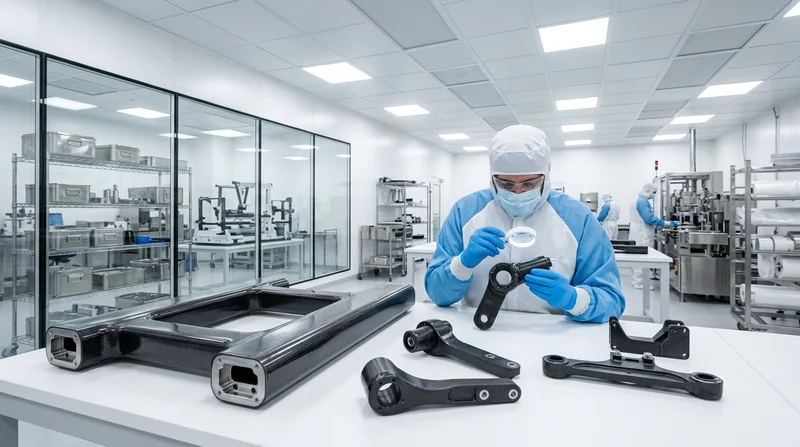
Custom Carbon Fiber Medical Device Components
Medical-grade carbon fiber components manufactured for imaging equipment, surgical instruments, and patient support systems. Carbon fiber's radiolucency (X-ray transparency) and high strength-to-weight ratio make it ideal for CT scanner beds, wheelchair frames, surgical robot arms, and MRI-compatible accessories. Biocompatible resin systems available.

Carbon Fiber Plate — 3K Twill T700 1.5mm
Thin 1.5mm carbon fiber plate with 3K twill weave surface. Lightweight and stiff, commonly used for covers, panels, drone bodies, and applications requiring a premium aesthetic appearance.

Square Carbon Fiber Tube — 3K Twill T700
Square cross-section carbon fiber tube manufactured with 3K twill weave for torsional strength. Preferred for structural frames, trusses, and support columns where rectangular geometry offers design flexibility.