
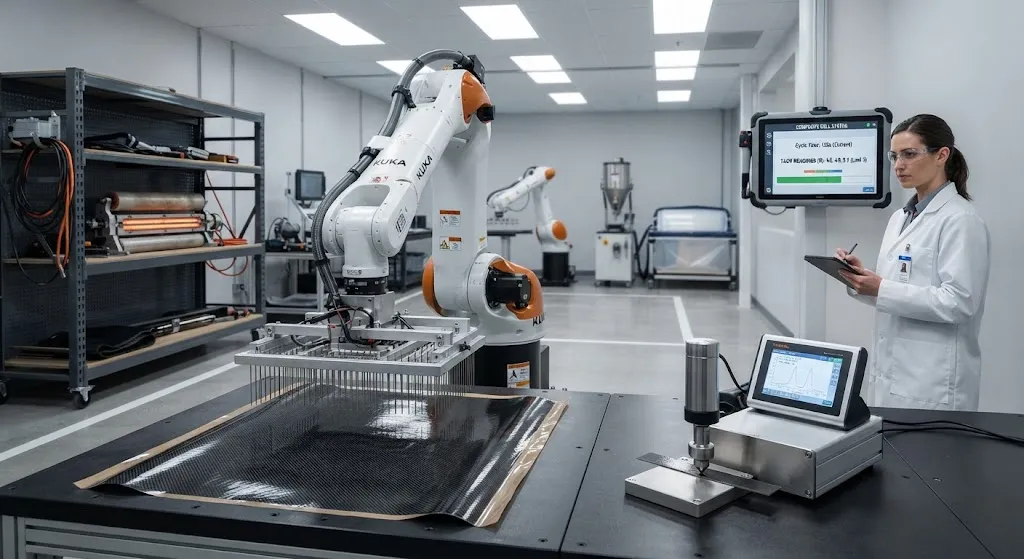
Automated layup is the bottleneck that decides whether aerospace composite production scales. From automated tape laying (ATL) heads that deposit 150-millimeter tapes, to automated fiber placement (AFP) systems placing 3.2-12.7 millimeter tows, to robotic pick-and-place cells that kitti
Introduction
Automated layup is the bottleneck that decides whether aerospace composite production scales. From automated tape laying (ATL) heads that deposit 150-millimeter tapes, to automated fiber placement (AFP) systems placing 3.2-12.7 millimeter tows, to robotic pick-and-place cells that kitting individual plies, every robotic process depends on the same material behavior: tack. Tack determines whether the material stays where the robot puts it, and whether it leaves where the robot picks it from.
Unlike a metal or a thermoplastic, a thermoset prepreg is a living material. Its tack changes with temperature, age, resin content, and even the pressure applied during deposition. An automation engineer therefore needs three things: a quantitative way to measure tack, an understanding of which process variables move it, and end-effector designs robust to the remaining variation. This article is organized around those three needs, with representative data throughout.
What Tack Is and How It Is Measured
Tack is the force or energy required to separate a prepreg ply from a substrate after a defined contact time at a defined pressure, with the bulk of the force captured in the first millimeters of the head-displacement. Two test families dominate industrial measurement: probe tack and peel tack.
Probe tack tests use a flat cylindrical probe, typically 6-25 millimeters in diameter, that contacts the prepreg surface under controlled pressure (0.1-2.0 MPa) for a set dwell time (0.1-10 seconds), then retracts at a controlled rate while the separation force is recorded. The result is a force-time curve whose peak value and area define the tack. Peel tack tests use a 90-degree or 180-degree peel geometry, drawing a defined width of material off a substrate and reporting peel force per width in newtons per 25 millimeters. Probe tack is preferred for material development because it is fast and insensitive to stiffness interference; peel tack is preferred for process qualification because it correlates with what the robot actually does.
What Drives Tack in the Material
The material variables that move tack are the same variables that move resin viscosity, because tack is fundamentally a contact-wetting phenomenon: the resin must flow into the substrate's surface roughness to build adhesive contact, and it must resist peel once that contact is formed.
- Resin content and formulation: Higher resin content on the surface means more available adhesive; tackifiers and reactive diluents shift the working window. Resin contents of 32-42 percent by weight are typical, and surface resin is often richer than bulk resin.
- Shelf life and out-time: As resin advances chemically, viscosity rises and tack falls. Prepreg stored at minus 18 degrees Celsius remains constant for months, but each day of out-time at 21 degrees Celsius advances cure and erodes tack measurably.
- Temperature: Resin viscosity typically falls steeply between 15 and 40 degrees Celsius, so tack maxima sit at the low-viscosity end of the working range. Most aerospace prepregs exhibit a broad tack window around 20-30 degrees Celsius; warming the material to 35-40 degrees Celsius is a common automation trick to recover tack.
- Pressure and dwell: Deposition pressure forces resin into the substrate texture; typical robotic compaction pressures are 0.2-0.7 MPa with dwell times of 1-5 seconds. Beyond these values the curve plateaus, so over-pressurizing does not buy more tack.
Tack Test Data: What the Numbers Look Like
Representative probe tack values give a sense of scale. A freshly thawed aerospace epoxy prepreg at 21 degrees Celsius, tested at 0.3 MPa for 5 seconds, typically yields peak probe forces of 5-15 N on a 12.7-millimeter probe. The same material after 10 days of out-time drops to 2-5 N; after 30 days it can fall below 1 N, where robotic handling becomes unreliable. Heating the fresh material to 35 degrees Celsius raises the peak to 15-25 N, effectively doubling the automation working window.
| Variable | Working Range | Tack Response | Automation Action |
|---|---|---|---|
| Resin content | 32-42 wt% | Higher content, higher tack | Specify surface-rich prepreg for pick-up |
| Out-time at 21 °C | 0-30 days | Steady decline, sharp below 10 days tail | Rotate stock, track age in MES |
| Temperature | 15-40 °C | Exponential increase with warming | Pre-heat plies to 30-40 °C before pick |
| Compaction pressure | 0.2-0.7 MPa | Rising then plateau | Hold pressure 2-3 s, do not force |
| Dwell time | 1-5 s | Logarithmic gain | Program dwell, not additional compaction |
| Probe tack peak (fresh) | 5-15 N | Process reference point | Set acceptance floor for handling |
The rightmost column is the engineering translation: tack data is not collected to be archived, it is collected to set process limits for the robot cell.
End-Effectors for Prepreg Pick-and-Place
A robotic layup cell typically alternates between picking from a cutting table or kit tray, and placing onto an open tool or into a cavity. The end-effector must therefore overcome two opposite requirements: enough grip to pull the ply off the backing paper or tray without draping, and clean release at placement.
The most common end-effector families are pin and needle grippers, vacuum grippers, and electrostatic grippers. Needle grippers pierce the ply with 1-4 millimeter needles and lift from the edges, reducing adhesion to the substrate; they work well for porous fabric prepreg but mark stiff laminates. Vacuum grippers hold the ply with distributed suction and release instantly on vent, but compete with resin adhesion — the process window is limited when tack exceeds about 10 N on 25 millimeters of peel. Electrostatic grippers generate attractive force on contact and release by reversing polarity; they do not touch the resin surface and are increasingly common for Class-A and cleanroom work, though they are sensitive to humidity.
Production cells frequently use hybrid end-effectors: a needle or vacuum frame for the pick, an active release stage with a peeling edge or air knife for the place, and in some cases a heated platen to control tack at the moment of transfer. The end-effector is effectively a small tack-management device, and its design data comes directly from the tack measurements above.
Automation Cell Performance Data
With controlled tack, robotic ply handling reaches impressive production metrics. A single-robot cell kitting automotive-grade structural plies of 300 by 300 to 800 by 500 millimeters typically cycles in 12-25 seconds per ply: pick, transfer, place, and compact. Placement accuracy of plus or minus 0.5 millimeters is routinely achieved with vision-guided correction. ATL and AFP heads deposit material at 20-60 meters per minute, with the tack window governing compaction-tow contact stability rather than overall head speed.
The failure modes that show up in practice are instructive. Cold material (below 15 degrees Celsius) produces ply slippage on transfer and edge lifting on curved tools; overheated material (above 45 degrees Celsius) produces resin squeeze-out at the compaction roller and fiber wash on the tool surface. Porous prepregs fail needle grips intermittently when the needles hit resin-rich zones. These are tack-driven failures, and they are addressed in the material specification, not in the robot program — another reason tack measurement belongs on the incoming inspection list.
Frequently Asked Questions
How do I know if my prepreg has enough tack for robotic handling?
Measure probe tack under conditions matching your cell: the same temperature, compaction pressure, and dwell time you will run. A practical acceptance floor for aerospace epoxy prepreg pick-and-place is a peak probe force of 5-8 N on a 12.7-millimeter probe at your cell temperature, with a clear safety margin above 3-4 N where handling becomes unreliable. If your material falls below the floor, warm it to 30-40 degrees Celsius or specify a higher-resin-content surface grade.
Which end-effector works best for highly tacky prepreg?
Highly tacky material favors needle pin grippers over vacuum, because vacuum competes with resin adhesion and loses grip authority precisely when the material is most difficult to handle. For flat plies from a kit tray, a perimeter needle frame with a peeling release stage gives the most dependable combination of grip and release. Electrostatic grippers are the cleanest option for Class-A surfaces but require dry, controlled humidity and add cost; evaluate them when surface quality or residual handling marks are disqualifying.
Does tack change during a robotic layup shift, and how do I keep it stable?
Yes. Resin self-heating from compaction friction, ambient temperature drift, and continued out-time all move tack during a production shift. The practical controls are: track prepreg out-time per roll and per kit, heat plies uniformly to a defined temperature before feeding the cell, and set a mid-shift tack audit — a 30-second probe measurement every few hours. Many plants run an automated tack probe on the robot itself, sampling the first ply of each kit as an inline process-health check.
Conclusion
Robotic prepreg handling is not solved by robots alone; it is solved by aligning material tack with end-effector design and cell process windows. Quantified tack testing gives the automation engineer the data to set acceptance floors, the process knowledge to manage temperature and out-time, and the design basis for end-effectors that can pick and release without damaging the laminate. Cell performance — 12-25 second cycles for structural plies, plus or minus 0.5 millimeter accuracy, and reliable contact stability in ATL and AFP — is achievable when tack is treated as a controlled process variable from incoming inspection through deposition.
For engineers building or tuning prepreg layup automation, review our prepreg and unidirectional carbon fiber materials, or contact our team to discuss tack specifications and process data for your robotic layup program.
Part of topic
Related Articles
- How Are Carbon Fiber Parts Made: Complete Guide
- Filament Wound Tube: Complete Guide
- Filament Wound FRP Pipe: Complete Guide
- Filament Wound Epoxy Tubes: Complete Guide
- Pultruded Carbon Fibre Rods: Cross-Sectional Properties and Standard Sizes
- Carbon Fiber Tube Fittings and Connectors: Joining Solutions for Structural Assemblies
Interested in Our Products?
Contact our team for competitive pricing and technical specifications.
Get a QuoteRelated Products
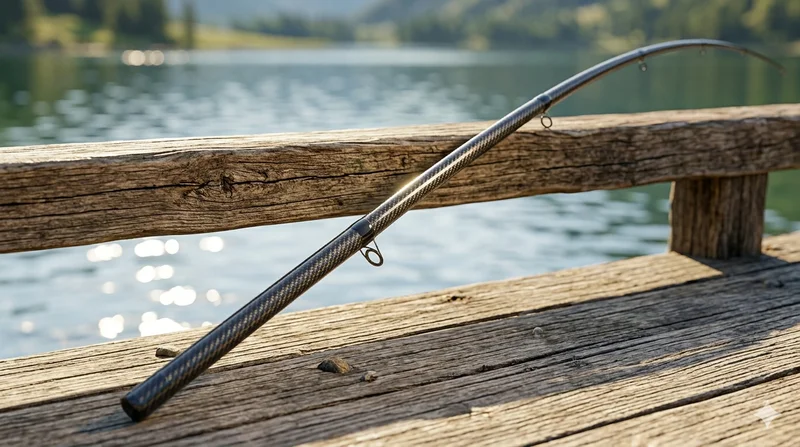
Carbon Fiber Fishing Rod Blank
High-quality carbon fiber fishing rod blank manufactured from multiple grades of Toray carbon fiber cloth. Available in a wide range of lengths, powers, and actions for freshwater and saltwater applications. Suitable for OEM rod building.
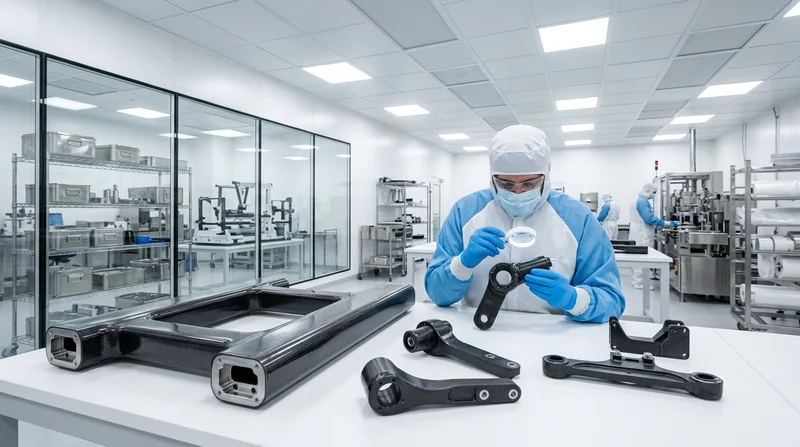
Custom Carbon Fiber Medical Device Components
Medical-grade carbon fiber components manufactured for imaging equipment, surgical instruments, and patient support systems. Carbon fiber's radiolucency (X-ray transparency) and high strength-to-weight ratio make it ideal for CT scanner beds, wheelchair frames, surgical robot arms, and MRI-compatible accessories. Biocompatible resin systems available.
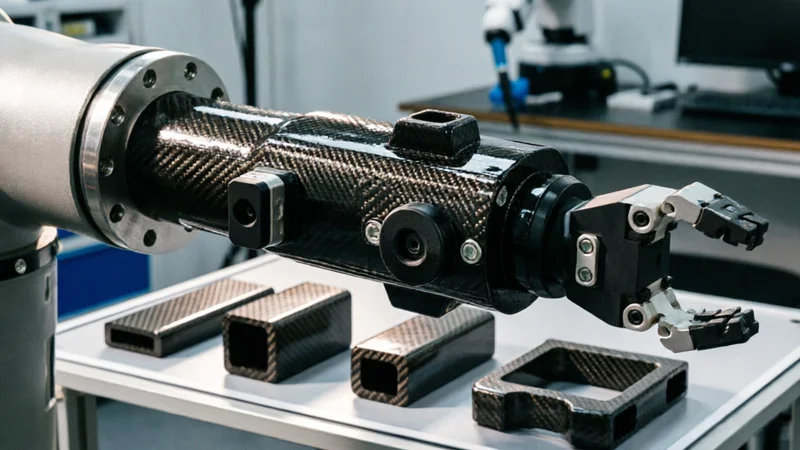
Carbon Fiber Robot End Effector Link — Custom Shape & Sensor Integration
Custom-shaped carbon fiber end effector links for robotic arms. Designed for automation integrators and research labs requiring lightweight, rigid connections between the robot wrist and gripper/tool. Can incorporate sensor mounting bosses, cable routing channels, and quick-change interfaces.
Round Carbon Fiber Tube — 3K Plain Weave T700
Standard round carbon fiber tube manufactured from Toray T700 grade fiber with 3K plain weave. Offers balanced strength and stiffness for general industrial applications including robotics, automation, sports equipment, and aerospace structures.

Custom Carbon Fiber Musical Instrument Parts
Carbon fiber components for musical instrument manufacturing offering superior dimensional stability, low weight, and consistent acoustic properties. We produce carbon fiber bows, guitar necks, violin chin rests, drum shells, and wind instrument bodies. Carbon fiber instruments are immune to humidity changes and temperature fluctuations that affect wooden instruments.