
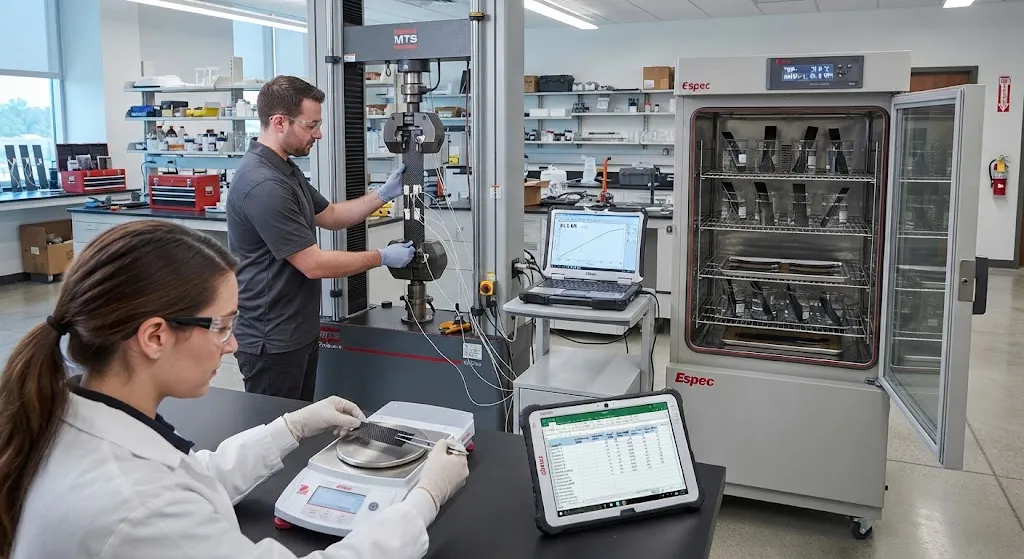
Carbon fiber composites are prized for their strength-to-weight ratio, but they are not immune to the environment. Every polymer matrix — epoxy, vinyl ester, bismaleimide, thermoplastic — absorbs moisture from humid air and liquid water, and absorbed moisture acts on the matrix in ways
Introduction
Carbon fiber composites are prized for their strength-to-weight ratio, but they are not immune to the environment. Every polymer matrix — epoxy, vinyl ester, bismaleimide, thermoplastic — absorbs moisture from humid air and liquid water, and absorbed moisture acts on the matrix in ways that gradually erode the material's mechanical performance. The process is slow, measured in months and years, which is precisely why it is dangerous: a structure can pass qualification at delivery and degrade quietly in service.
The engineering term for this interplay is hygrothermal aging — the combined, coupled action of moisture and temperature over time. Understanding moisture absorption matters across the industries that rely on carbon fiber: aircraft skins that spend decades cycling between humid ground conditions and dry cruise altitudes, ship hulls permanently immersed in seawater, and wind turbine blades that absorb rain and humidity through decades of operation. This article covers the mechanism of moisture diffusion, its effect on key mechanical properties, the standards used to characterize it, and the design measures that keep composites serviceable for their full design life.
The Mechanism: Fickian Diffusion in the Polymer Matrix
Moisture enters a composite through the matrix, not through the fibers. Carbon fibers themselves are essentially impermeable to water, and the fiber-matrix interface can act as a fast path under some conditions, but at the continuum level the governing process is diffusion of water molecules into the polymer network. For most epoxy systems, absorption follows Fickian behavior: the mass gain rises rapidly at first, then decelerates, and finally plateaus at a saturation level.
Two material-level constants describe this behavior. The saturation content — the equilibrium percentage of absorbed water at a given humidity — typically lands between 1 and 2 percent of matrix weight for standard epoxies, and between 0.5 and 1.5 percent for the composite laminate as a whole depending on fiber volume fraction and porosity. The diffusion coefficient controls the rate of approach to saturation and depends strongly on temperature: diffusivity rises roughly an order of magnitude over a 50 degree Celsius increase in exposure temperature. This is why a hot, humid environment ages a part far faster than a cold, dry one — the same physics, accelerated.
How Moisture Changes the Matrix: Plasticization and Tg Depression
Absorbed water does three things to the polymer matrix. First, it plasticizes the network: water molecules intercalate between polymer chains, reducing their interaction and softening the material. Second, it depresses the glass transition temperature — the temperature above which the matrix loses its rigid, glassy behavior. Third, it swells the matrix and, combined with thermal cycling, can generate microcracks.
Tg depression is the most consequential effect for design. A typical rule of thumb is a drop of roughly 15 to 25 degrees Celsius per one percent of absorbed moisture by weight. A matrix with a dry Tg of 180 degrees Celsius can fall to around 150 degrees Celsius after saturation — and if the operating temperature approaches the depressed Tg, the matrix softens, stiffness falls, and creep and microcracking accelerate. Designers therefore specify an adequate wet-Tg margin: the glass transition temperature measured on a saturated specimen must remain safely above the maximum service temperature.
Effect on Mechanical Properties
Not all properties are affected equally. Because the fibers carry most of the tensile load, tensile strength and modulus are relatively insensitive to moisture at the laminate level. Properties dominated by the matrix are the most sensitive:
- Compressive strength: Matrix-dominated compression — and the fiber microbuckling it controls — falls by up to 20-30 percent in saturated specimens in published studies.
- Interlaminar shear strength: Shear transfer through the matrix and fiber-matrix interface drops by a similar order of magnitude.
- Fatigue behavior: Moisture accelerates damage accumulation and reduces fatigue life, particularly in off-axis and shear-dominated loading.
- Fracture toughness: Mode I and Mode II toughness are degraded at elevated temperature in the wet state; the effect at room temperature is smaller.
The table below summarizes typical retention values for a standard-modulus carbon fiber/epoxy laminate after saturation in humid air.
| Property | Typical Retention after Saturation | Dominant Degradation Mechanism |
|---|---|---|
| Tensile strength | 90-100% | Fiber-dominated; minor interface effects |
| Tensile modulus | 95-100% | Fiber-controlled |
| Compressive strength | 70-80% | Matrix plasticization and microbuckling |
| Interlaminar shear strength | 70-85% | Matrix and interface degradation |
| Glass transition temperature | Dry Tg minus 15-25 degrees Celsius per 1% moisture | Network plasticization |
| Fatigue life | Reduced; load-level dependent | Accelerated damage growth |
Testing Standards and Qualification Practice
Hygrothermal behavior is characterized with a well-established set of test practices. ASTM D5229 defines the standard test method for moisture absorption properties and equilibrium conditioning of polymer matrix composite materials, covering specimen preparation, conditioning to saturation, and measurement of mass gain and diffusivity. Aerospace programs typically condition coupons to the worst-case service environment — a specified hot-wet condition matching the most severe humidity and temperature combination the part will see — before mechanical testing.
Qualification practice therefore pairs two campaigns: environmental conditioning and property testing. Specimens are preconditioned to saturation or to a defined moisture level, then tested at the relevant temperature to establish wet properties, and the same coupons are used to measure the wet Tg. Data from these campaigns feed allowables and design margins: if the wet compressive strength falls below the design stress, the laminate thickness is increased or the material system is changed. The approach is deliberately conservative because moisture absorption is slow and difficult to reverse — drying is far slower than wetting, and full recovery is rarely achieved in service.
Mitigation and Design for Durability
Designers have a practical toolkit for managing moisture aging in carbon fiber structures:
- Material selection: Choose matrix systems with low equilibrium moisture content and high wet Tg; bismaleimide and toughened epoxies outperform standard epoxies in hot-wet conditions.
- Surface protection: Seal edges and apply durable coatings to slow moisture ingress through cut edges, where diffusion is fastest.
- Processing control: Minimize porosity during cure, because voids provide reservoirs and fast paths for moisture.
- Wet-basis allowables: Base structural allowables and margins on saturated, hot-wet properties rather than dry room-temperature values.
- In-service monitoring: Periodic inspection and, where critical, embedded sensing or scheduled recoating manage long-term exposure.
These measures do not eliminate moisture absorption — no practical surface treatment makes a polymer fully impermeable. They manage its consequences, keeping the depressed Tg and degraded matrix properties inside the design envelope for the full service life.
Frequently Asked Questions
Why does moisture affect compressive strength more than tensile strength?
Tensile strength in a carbon fiber laminate is dominated by the fibers, which are essentially impermeable to water and retain their properties in the wet state. Compressive strength, by contrast, depends on the matrix supporting the fibers: absorbed water plasticizes the matrix and lowers its stiffness, which reduces the support against fiber microbuckling under compression. The same logic explains why interlaminar shear strength — a matrix- and interface-controlled property — also degrades significantly with moisture.
What is the glass transition temperature depression caused by moisture?
Absorbed water plasticizes the polymer network by reducing the interactions between polymer chains. The practical consequence is that the glass transition temperature falls by roughly 15 to 25 degrees Celsius per one percent of absorbed moisture by weight. Designers manage this by specifying a wet-Tg margin, so that the saturated state remains safely above the maximum service temperature.
How is moisture absorption measured and qualified?
The standard test method is ASTM D5229, which covers moisture absorption properties and equilibrium conditioning of polymer matrix composites. Coupons are conditioned to saturation at a defined humidity and temperature, their mass gain is monitored, and the wet properties — including Tg, compression and interlaminar shear strength — are then measured. Aerospace qualification uses a hot-wet worst-case condition, so that the wet allowables used in design represent the harshest realistic service environment.
Conclusion
Moisture absorption is a slow, diffuse and ultimately inescapable part of carbon fiber composite service life. Absorbed water plasticizes the polymer matrix, depresses the glass transition temperature, and reduces the matrix-dominated properties — compression, interlaminar shear and fatigue resistance — that often set the design limit. The engineering response is not to prevent absorption entirely, which is impractical, but to characterize it properly with standards such as ASTM D5229, to design against wet, saturated properties, and to protect surfaces and edges so that aging unfolds slowly within a well-defined envelope.
YongXian supplies carbon fiber fabrics and reinforcement materials engineered for durable composite structures in aerospace, marine and wind energy applications. Explore our carbon fiber product range or contact our engineering team to discuss material systems for your application environment.
Part of topic
Related Articles
- How Are Carbon Fiber Parts Made: Complete Guide
- Filament Wound Tube: Complete Guide
- Filament Wound FRP Pipe: Complete Guide
- Filament Wound Epoxy Tubes: Complete Guide
- Pultruded Carbon Fibre Rods: Cross-Sectional Properties and Standard Sizes
- Carbon Fiber Tube Fittings and Connectors: Joining Solutions for Structural Assemblies
Interested in Our Products?
Contact our team for competitive pricing and technical specifications.
Get a QuoteRelated Products
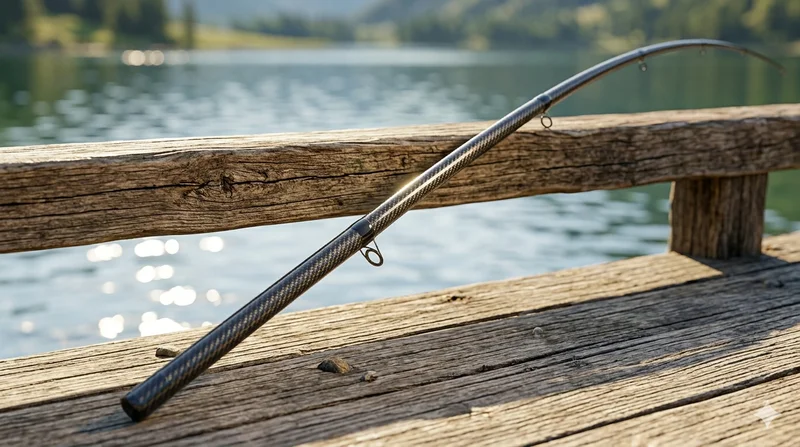
Carbon Fiber Fishing Rod Blank
High-quality carbon fiber fishing rod blank manufactured from multiple grades of Toray carbon fiber cloth. Available in a wide range of lengths, powers, and actions for freshwater and saltwater applications. Suitable for OEM rod building.

Carbon Fiber Plate — 3K Twill T700 3.0mm
Medium-thickness 3.0mm carbon fiber plate offering significantly higher load capacity while maintaining attractive 3K twill finish. Suitable for structural brackets, reinforcement plates, and load-bearing panels.
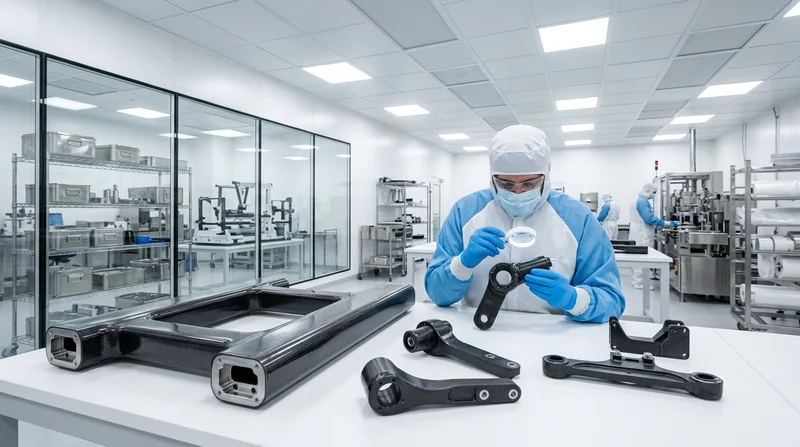
Custom Carbon Fiber Medical Device Components
Medical-grade carbon fiber components manufactured for imaging equipment, surgical instruments, and patient support systems. Carbon fiber's radiolucency (X-ray transparency) and high strength-to-weight ratio make it ideal for CT scanner beds, wheelchair frames, surgical robot arms, and MRI-compatible accessories. Biocompatible resin systems available.

Carbon Fiber Plate — 3K Twill T700 1.5mm
Thin 1.5mm carbon fiber plate with 3K twill weave surface. Lightweight and stiff, commonly used for covers, panels, drone bodies, and applications requiring a premium aesthetic appearance.

Square Carbon Fiber Tube — 3K Twill T700
Square cross-section carbon fiber tube manufactured with 3K twill weave for torsional strength. Preferred for structural frames, trusses, and support columns where rectangular geometry offers design flexibility.