
Carbon fiber composites owe their position in primary aerospace structure to specific stiffness and strength, but their weakness is well documented: the interlaminar region is matrix-dominated, and delamination is the failure mode that most often limits design. When a composite panel is
Introduction
Carbon fiber composites owe their position in primary aerospace structure to specific stiffness and strength, but their weakness is well documented: the interlaminar region is matrix-dominated, and delamination is the failure mode that most often limits design. When a composite panel is struck by a tool, a bird, or runway debris, barely visible impact damage can create delaminations that cut compressive strength by 40-60% unless the laminate is toughened. The certification property that captures this, compression after impact (CAI) strength, has become the single most important material selection criterion for carbon fiber prepreg in flight-critical structure.
Two families of technology dominate production interlaminar toughening. The first inserts a thermoplastic veil, a thin non-woven mat of nylon, polyetherimide, or polyphenylene sulfide fibers, at the ply interfaces. The second modifies the resin itself with particles, most commonly thermoplastic particles or elastomer particles, so that the matrix resists crack propagation from within. Both approaches raise fracture toughness and CAI, but they differ in processing, cost, weight, and the mechanical properties they trade away. This article quantifies those differences and gives engineers the framework to choose between them.
Why Interlaminar Toughness Controls CAI
Impact damage in a laminate is a set of matrix cracks and delaminations, and its effect on strength appears only under compression. When the panel is compressed, the delaminated sub-laminates buckle in opposite directions, and the buckled plies drive the delamination to grow in Mode II (shear) fracture. The laminate's resistance to this growth, its Mode II interlaminar fracture toughness, GIIc, is therefore the property that sets CAI strength. Higher GIIc means the delamination grows more slowly under the same compressive load, sustaining a higher failure stress.
Unmodified aerospace epoxy laminates exhibit GIIc values of roughly 300-600 J/m² and CAI strengths of 150-220 MPa at a standard impact energy of 30 Joules. Toughening routes push GIIc to 800-1,500 J/m² and CAI to 250-350 MPa, a gain large enough to change a structural design: skin gauges can be reduced, inspection intervals lengthened, and barely visible impact damage no longer drives the repair decision in every case.
The Toughening Mechanisms at the Interface
Toughening works by giving the crack a more difficult path through the interlaminar region. In an untoughened laminate, a crack runs cleanly through the brittle resin at the interface. Toughening inserts energy-dissipating mechanisms that force the crack to do more work per unit of crack area:
- Crack bridging by ductile fibers: thermoplastic veil fibers span the crack faces, carrying load as the crack opens and requiring extra energy to pull out or break.
- Plastic zone development: toughener particles and the surrounding resin deform plastically ahead of the crack tip, absorbing energy before the crack can advance.
- Crack deflection and bifurcation: a particle-modified interface redirects the crack into a tortuous path, increasing the effective fracture surface area.
- Stress redistribution at the crack tip: a tougher interlayer spreads the stress over a larger volume, delaying the onset of unstable crack growth.
All four mechanisms coexist to different degrees in veils and particle-modified resins, which is why both routes work, but their efficiency differs by resin system, fiber areal weight, and the target application.
Thermoplastic Veils: Construction and Performance
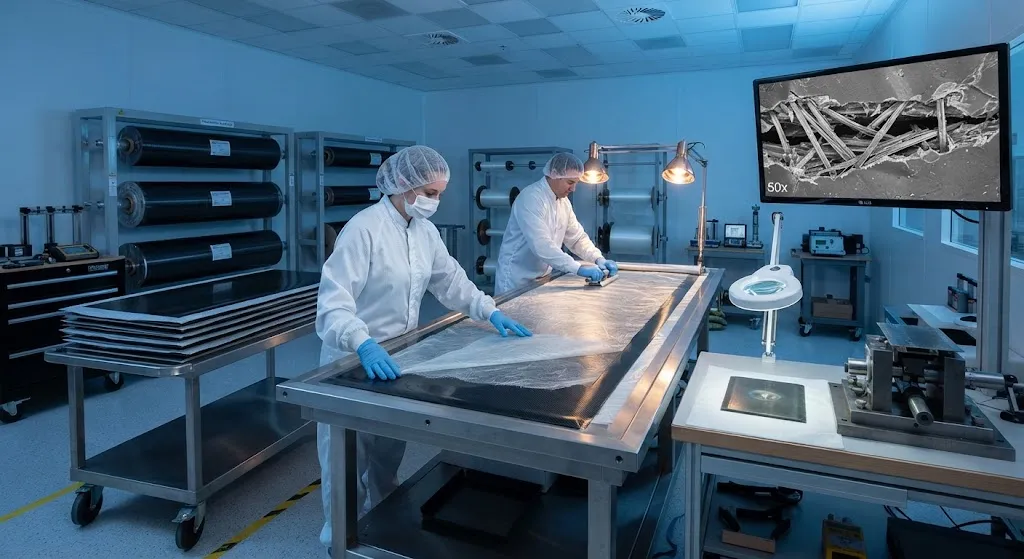
A thermoplastic veil is a non-woven mat, typically 5-20 grams per square meter, of thermoplastic fibers placed between carbon plies during prepreg layup. Nylon veils are the most common in production, with polyetherimide (PEI) and polyphenylene sulfide (PPS) veils used where higher service temperature or resin compatibility demands them. The veil fibers are compatible with the epoxy matrix, and during cure they either remain as discrete fibers or partially dissolve and re-precipitate, forming a toughened interlayer 20-80 micrometers thick.
| Toughening approach | Typical GIIc (J/m²) | Typical CAI at 30 J (MPa) | Added weight (g/m²) | Processing impact |
|---|---|---|---|---|
| Untoughened epoxy prepreg | 300-600 | 150-220 | 0 | Baseline |
| Particle-modified resin prepreg | 700-1,200 | 250-320 | 15-40 (resin) | Minor; prepreg slightly stiffer |
| Thermoplastic veil interlayer | 800-1,500 | 250-350 | 5-20 (veil) | Extra ply placement step |
| Particle-modified resin plus veil | 1,200-1,800 | 300-380 | 25-60 | Both of the above |
Veils deliver the largest GIIc gains with the smallest added weight, which is why they appear in the highest-performance prepreg systems. The price is a processing penalty: each veil is a separate ply in the layup, increasing labor and trim waste, and veil placement must be precise to avoid resin starvation at the interface. Veils also add a small thickness to the laminate, which can matter in tightly toleranced skins.
Particle-Modified Resins: Toughening From Within
Particle-modified resins disperse toughener particles throughout the matrix rather than placing them only at the interface. Two particle families are used. Thermoplastic particles, typically polyetherimide or polyethersulfone, stay discrete during cure and dissolve partially into the epoxy, creating a semi-interpenetrating network that raises fracture toughness without sharply raising viscosity. Elastomer particles, traditionally carboxyl-terminated butadiene nitrile rubber, precipitate as a separate rubber phase and deliver high toughness at the cost of a lower hot-wet modulus and glass transition temperature.
Because the particles are in the resin, toughening is distributed through the ply thickness, protecting against microcracks that form between plies, not just at the interface. This is a real advantage in thick laminates and in high-temperature service where thermal cycling drives matrix cracking. The processing cost is milder than veils: the prepreg remains a single material, layup is unchanged, and the added weight is in the resin rather than in additional plies. The trade-off is a stiffer, more viscous prepreg that is harder to drape into complex geometry and slightly lower hot-wet performance from the rubber-modified systems.
Design Trade-offs and Selection Criteria
The choice between veils and particle-modified resins is rarely made on toughness alone. Engineers weigh five factors:
- Weight and thickness: veils add the least weight per unit of toughness gain but add laminate thickness; particle-modified resin adds weight distributed through the matrix without changing ply count.
- Processing and cost: particle-modified prepreg keeps the standard layup; veils add placement steps, labor, and trim waste. For high-rate production, particles usually win on cost per part.
- Hot-wet performance: thermoplastic-based toughening preserves the glass transition temperature better than rubber-based systems, which matters in engine nacelle and wing skin applications near service temperature limits.
- Damage tolerance requirements: the highest CAI values come from combining both routes, which is why some flagship aerospace prepregs use particle-modified resin with an integrated veil.
- Repair and bonding: toughened interfaces change surface preparation and adhesive bonding behavior; a veil at the surface can complicate repairs unless the repair scheme accounts for it.
In practice, particle-modified resins dominate where production rate and cost dominate, notably fuselage panels and wing skins, while veils appear where maximum CAI per kilogram is required, such as empennage boxes and control surfaces. The two are increasingly combined in the newest primary structure programs.
Frequently Asked Questions
How much does interlayer toughening improve CAI strength?
At a standard 30 Joule impact, untoughened aerospace epoxy prepreg laminates typically show CAI strengths of 150-220 MPa. Thermoplastic veils raise this to roughly 250-350 MPa, and particle-modified resins to 250-320 MPa, gains of 50-100%. Combining both approaches reaches 300-380 MPa. The same toughening roughly doubles Mode II interlaminar fracture toughness, from 300-600 J/m² to 800-1,500 J/m², and the improved damage tolerance translates directly into thinner skins and longer inspection intervals in certification.
What is the difference between thermoplastic veils and particle-modified resins?
A thermoplastic veil is a separate non-woven mat of thermoplastic fibers placed at the ply interface, adding a distinct tough interlayer without changing the resin. Particle-modified resin disperses toughener particles throughout the matrix, toughening the whole ply. Veils deliver the highest toughness per unit of added weight but add a layup step and laminate thickness; particle-modified resin keeps the standard prepreg and layup but adds weight in the resin and can be stiffer and less drapeable. High-performance systems increasingly combine both.
Does interlayer toughening reduce the in-plane properties of the laminate?
Interlaminar toughening has a small effect on in-plane strength and stiffness, typically a 2-5% reduction in laminate compressive and tensile properties in the toughened systems, because the tougher interlayer and any added resin reduce the fiber volume fraction slightly. The trade is almost always favorable: the CAI gain of 50-100% is worth far more than a few percent of in-plane strength in a primary structure, and system-level weight savings from thinner skins outweigh the local property loss.
Conclusion
Interlayer toughening is not an option for primary aerospace structure; it is the mechanism that makes carbon fiber composites flyable in damage-critical applications. Thermoplastic veils and particle-modified resins both raise Mode II fracture toughness and CAI strength by 50-100%, and the two routes are converging: the newest prepregs combine particle-modified resin with integrated veils to reach CAI values above 300 MPa while managing weight and processing cost. For engineers selecting materials, the decision framework is the interaction of five factors: weight, processing cost, hot-wet performance, damage tolerance target, and repair behavior.
For teams evaluating toughened prepreg for a new program, the practical path is to establish the CAI and GIIc targets from the structural loads first, then compare candidate systems on the full set of trade-offs rather than toughness alone. Explore our carbon fiber prepreg and reinforcement range, or contact our engineering team to discuss toughening strategies and material selection for your application.
Part of topic
Related Articles
- Pultruded Carbon Fibre Rods: Cross-Sectional Properties and Standard Sizes
- Carbon Fiber Tube Fittings and Connectors: Joining Solutions for Structural Assemblies
- Carbon Fiber Plate Insert: Threaded Insert Design for Composite Structures
- Filament Wound Epoxy Tubing: Selection Guide for Industrial and Aerospace Applications
- Filament Wound Epoxy Tubes Advantages: Over Metal and Pultruded Alternatives
- Carbon Fiber Tube Strength: Analysis Methods and Design Allowables
Interested in Our Products?
Contact our team for competitive pricing and technical specifications.
Get a QuoteRelated Products
Carbon Fiber Fishing Rod Blank
High-quality carbon fiber fishing rod blank manufactured from multiple grades of Toray carbon fiber cloth. Available in a wide range of lengths, powers, and actions for freshwater and saltwater applications. Suitable for OEM rod building.

Carbon Fiber Plate — 3K Twill T700 1.5mm
Thin 1.5mm carbon fiber plate with 3K twill weave surface. Lightweight and stiff, commonly used for covers, panels, drone bodies, and applications requiring a premium aesthetic appearance.

Carbon Fiber Plate — 3K Twill T700 3.0mm
Medium-thickness 3.0mm carbon fiber plate offering significantly higher load capacity while maintaining attractive 3K twill finish. Suitable for structural brackets, reinforcement plates, and load-bearing panels.
Custom Carbon Fiber Medical Device Components
Medical-grade carbon fiber components manufactured for imaging equipment, surgical instruments, and patient support systems. Carbon fiber's radiolucency (X-ray transparency) and high strength-to-weight ratio make it ideal for CT scanner beds, wheelchair frames, surgical robot arms, and MRI-compatible accessories. Biocompatible resin systems available.

Square Carbon Fiber Tube — 3K Twill T700
Square cross-section carbon fiber tube manufactured with 3K twill weave for torsional strength. Preferred for structural frames, trusses, and support columns where rectangular geometry offers design flexibility.