
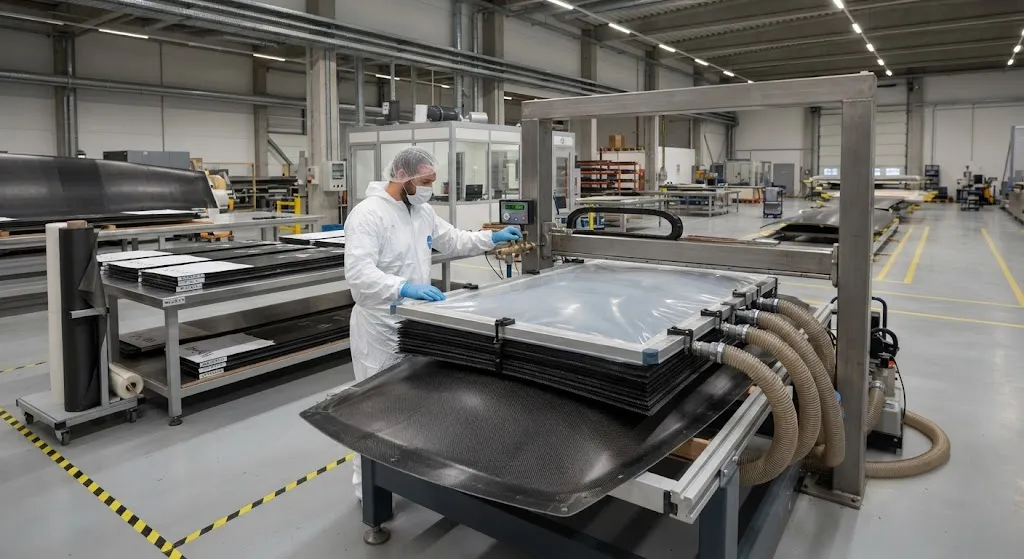
Every large carbon fiber structure — a wing skin, a wind blade shear web, an automotive floor pan — starts with a decision about how to turn flat material into a three-dimensional shape. Automated fiber placement (AFP) extrudes slit tow directly onto a contoured tool, at the cost of mil
Introduction
Every large carbon fiber structure — a wing skin, a wind blade shear web, an automotive floor pan — starts with a decision about how to turn flat material into a three-dimensional shape. Automated fiber placement (AFP) extrudes slit tow directly onto a contoured tool, at the cost of millions of dollars in gantry machinery. Double diaphragm forming (DDF) takes a much older route: lay the material flat, seal it between two flexible sheets, and pull the whole stack over the tool with vacuum pressure. For dry fiber preforms that are later infused with resin, DDF routinely undercuts AFP capital by an order of magnitude while holding fiber alignment within the limits the part actually needs.
This article walks through the forming physics, compares DDF with AFP on capital, throughput, and quality using representative production figures, and closes with the application logic that decides which process belongs on which factory floor. The comparison is deliberately quantitative, because the choice between a multi-million-dollar placement machine and a vacuum-forming work cell is a business decision as much as an engineering one.
The Double Diaphragm Forming Process
The process chain is short enough to run on one shift. Cut plies of dry fabric, non-crimp fabric, or unidirectional material are assembled into a flat stack on a layup table; the stack is placed between two elastic diaphragms; the cavity between the diaphragms is evacuated so the stack consolidates and locks in place; and the sealed package is lowered onto a male or female forming tool while the space above the package is drawn down to vacuum. Atmospheric pressure then drapes the stack over the tool in a few minutes. A single-diaphragm variant replaces the second membrane with the rigid tool surface, which is cheaper on tooling but leaves one face of the stack exposed to handling.
The diaphragm is the heart of the process: an elastic sheet, typically silicone or neoprene 0.5-1.5 millimeter thick, that stretches to conform to the tool. Where it stretches more, adjacent plies slide relative to each other, so the stiffness and elongation profile of the diaphragm largely determine whether the stack forms cleanly or wrinkles. The double configuration adds two practical advantages. First, the plies are sealed between two membranes, so both faces stay free of contamination and the stack cannot separate during handling. Second, the inter-diaphragm vacuum can be controlled independently of the forming vacuum, which gives operators a second knob for managing ply compaction during the drape.
Cost and Rate Comparison with AFP
The economic case for DDF rests on numbers that look like this for a representative large shallow part, such as a regional aircraft wing skin or a wind blade shear web:
| Metric | AFP Direct Placement | DDF + Resin Infusion |
|---|---|---|
| Machine capital cost | USD 2-6 million per gantry | USD 0.3-1.5 million per work cell |
| Material form | Slit tow, dry or prepreg | Dry fabric, non-crimp fabric, dry UD |
| Throughput | 5-15 kg/h typical in production | Flat layup 20-40 kg/h, forming 5-15 min per part |
| Fiber placement precision | Tow-level, program controlled | Fabric-level, limited by drape |
| Wrinkle risk | Low | Moderate, strongly geometry dependent |
| Tooling cost | One contoured tool per part | Flat layup table plus forming tool |
| Non-destructive inspection burden | Moderate | Higher, wrinkle and porosity checks |
| Best fit | Complex crowned geometry, high output | Large shallow parts, low-to-mid series |
AFP machines are expensive for a reason: they control fiber position to the width of a tow and lay material at tow-level resolution onto surfaces that would wrinkle any fabric. In service, though, a large gantry system averages closer to 5-15 kilograms of deposited fiber per hour once head changes, creep pauses, and rework downtime are counted, and the machine itself amortizes across the parts it feeds. DDF shifts the work to a flat layup cell, where robotic pick-and-place or simple templates lay 20-40 kilograms per hour, and the forming step itself takes minutes. The tooling story is just as lopsided: AFP needs a contoured tool machined to exact geometry, whereas DDF forms on a flat layup table and a relatively simple forming tool. The Airbus A350 rear pressure bulkhead, produced as a dry preform with resin infusion, demonstrated that the dry route scales to the largest aerostructures in service — the same economics that make DDF attractive at smaller scale.
Wrinkle Control and Forming Quality
Fabric deforms by in-plane shear, the trellis mechanism in which yarns rotate at the crossover points. When the local shear angle passes roughly 30-40 degrees, the fabric locks and further deformation produces out-of-plane wrinkles — the defect DDF is most criticized for. Cross-ply stacks shear far more easily than unidirectional material, which is why quasi-isotropic laminates form deeper parts than tape-only stacks. Tool geometry is the other half of the story: parts with steep tapers, deep crowns, or concave pockets exceed what any flat fabric can conform to, regardless of diaphragm tuning.
Modern DDF cells manage the risk with a combination of controls. Diaphragm selection sets the base behavior; controlling the evacuation rate lets the stack form progressively instead of slamming onto the tool; thermoplastic binder powder, activated at 80-120 degrees Celsius, locks plies into place before the forming vacuum is applied; and drape simulation software predicts shear angle maps before any tool steel is cut. Quality control then follows with ultrasonic or near-infrared inspection plus shear-angle verification on the formed preform, catching wrinkles before expensive resin infusion commits to them.
Where DDF Fits in Production
- Wing and empennage skins for regional aircraft, eVTOL, and urban air mobility platforms — shallow curvature combined with resin infusion or vacuum-assisted resin transfer molding.
- Wind blade shear webs, root sections, and trailing-edge panels, where flat layup and fast forming beat tow placement on cost.
- Automotive closures and floor structures for low-to-mid series sports cars, where the capital difference matters more than tow-level precision.
- Marine hull panels, masts, and deck structures formed from dry fabric and infused in one operation.
- Hybrid strategies: a DDF preform gives the global geometry, and localized AFP patches add reinforcement exactly where loads concentrate.
AFP remains the right answer where geometry defeats fabric drape — deep crowned fuselage sections, steep tapers, and parts that demand tow-by-tow steering for variable stiffness. For the large, shallow, higher-symmetry parts that dominate wing and blade volume, DDF converts the same engineering intent into a preform at capital costs an order of magnitude lower.
Frequently Asked Questions
Can a DDF preform reach the same fiber volume fraction as an AFP layup?
Yes, within a few points for shallow parts, because the fiber volume fraction of an infused preform is set mainly by the infusion and compaction step, not by the forming step. A vacuum-assisted resin transfer molding process on a DDF preform typically lands at 55-60 percent fiber volume, compared with 60-68 percent for autoclave-cured prepreg laid by AFP. For parts where those points are structural, a DDF preform can be locally compacted or paired with AFP patches to lift the material content where it matters.
Why use two diaphragms instead of one?
The second diaphragm contains the ply stack completely: both faces stay clean, the plies cannot separate during handling, and the inter-diaphragm vacuum can be set independently of the forming vacuum, which gives the operator two independent pressure controls during drape. Single-diaphragm forming is simpler and cheaper, but it exposes one face of the stack and gives up that independent compaction control, which makes double forming the preferred configuration for aerospace-grade quality.
At what production volume does AFP become cheaper per part than DDF?
There is no universal crossover point, because geometry drives it: AFP pays for itself on parts with deep crowns or steep tapers where DDF would wrinkle, at almost any volume. For the large shallow parts that DDF forms cleanly, the capital gap is wide enough that DDF remains competitive at surprisingly high rates — the crossover typically sits far above the volumes that regional aircraft and wind blade programs actually reach. Programs that need both usually run the two processes side by side rather than choosing one.
Conclusion
Double diaphragm forming is the quiet answer to a loud problem. AFP delivers precision nobody questions at a capital cost everybody questions, and for the large, shallow, resin-infused structures that dominate wing and blade production, DDF buys nearly all of the geometric benefit for a tenth of the machine spend. The process physics are well understood, the wrinkle controls are standard practice, and the dry preform route unlocks a step change in tooling and throughput economics for low-to-mid series production.
For engineers evaluating preform technology, the dry fiber supply chain is the foundation of the whole comparison. Explore our dry carbon fiber fabrics and non-crimp fabrics, or contact our engineering team to model DDF versus AFP economics for your wing, blade, or automotive program.
Part of topic
Related Articles
- Filament Wound FRP Pipe: Complete Guide
- Filament Wound Epoxy Tubes: Complete Guide
- Pultruded Carbon Fibre Rods: Cross-Sectional Properties and Standard Sizes
- Carbon Fiber Tube Fittings and Connectors: Joining Solutions for Structural Assemblies
- Carbon Fiber Plate Insert: Threaded Insert Design for Composite Structures
- Filament Wound Epoxy Tubing: Selection Guide for Industrial and Aerospace Applications
Interested in Our Products?
Contact our team for competitive pricing and technical specifications.
Get a QuoteRelated Products
Carbon Fiber Fishing Rod Blank
High-quality carbon fiber fishing rod blank manufactured from multiple grades of Toray carbon fiber cloth. Available in a wide range of lengths, powers, and actions for freshwater and saltwater applications. Suitable for OEM rod building.
Carbon Fiber Drone Arm
Precision-molded carbon fiber drone arm combining unidirectional fiber for stiffness and woven layers for torsional strength. Designed for FPV, photography, and industrial drone platforms. Each arm is CNC-machined to exact specifications.
Carbon Fiber Plate — UD Unidirectional T700
Unidirectional carbon fiber plate with all fibers oriented in a single direction for maximum strength along the fiber axis. Essential for structural reinforcements, splints, and applications where load direction is predictable.
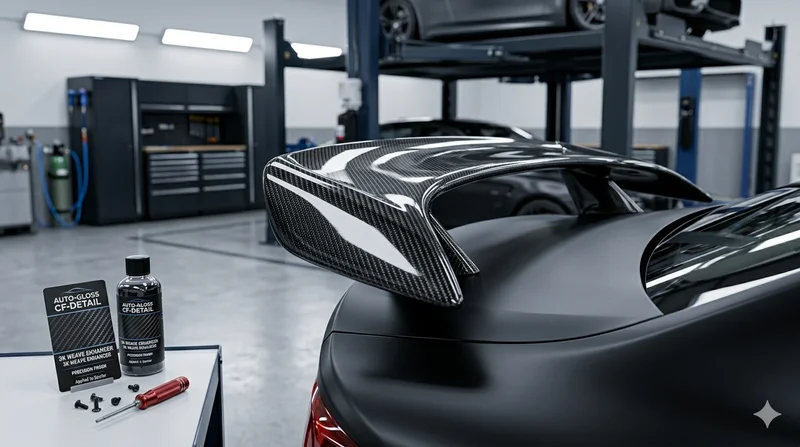
Carbon Fiber Automotive Spoiler
Automotive-grade carbon fiber spoiler manufactured using autoclave-cured pre-preg technology. Each spoiler is vacuum-bagged and oven-cured for optimal fiber-to-resin ratio, strength, and a flawless cosmetic finish.
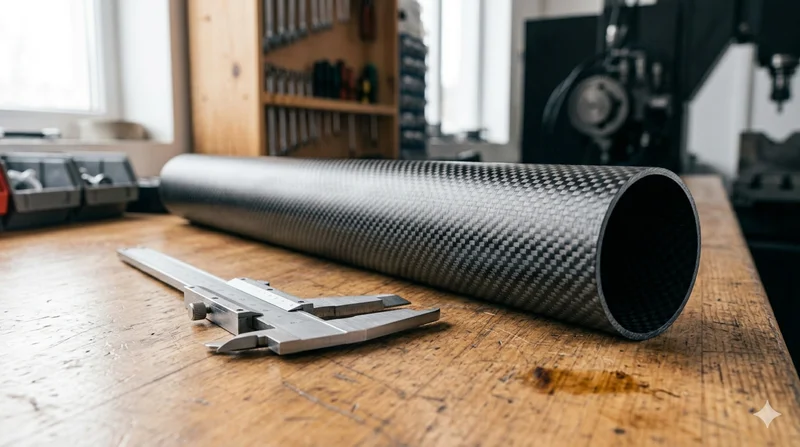
Round Carbon Fiber Tube — 3K Plain Weave T700
Standard round carbon fiber tube manufactured from Toray T700 grade fiber with 3K plain weave. Offers balanced strength and stiffness for general industrial applications including robotics, automation, sports equipment, and aerospace structures.