
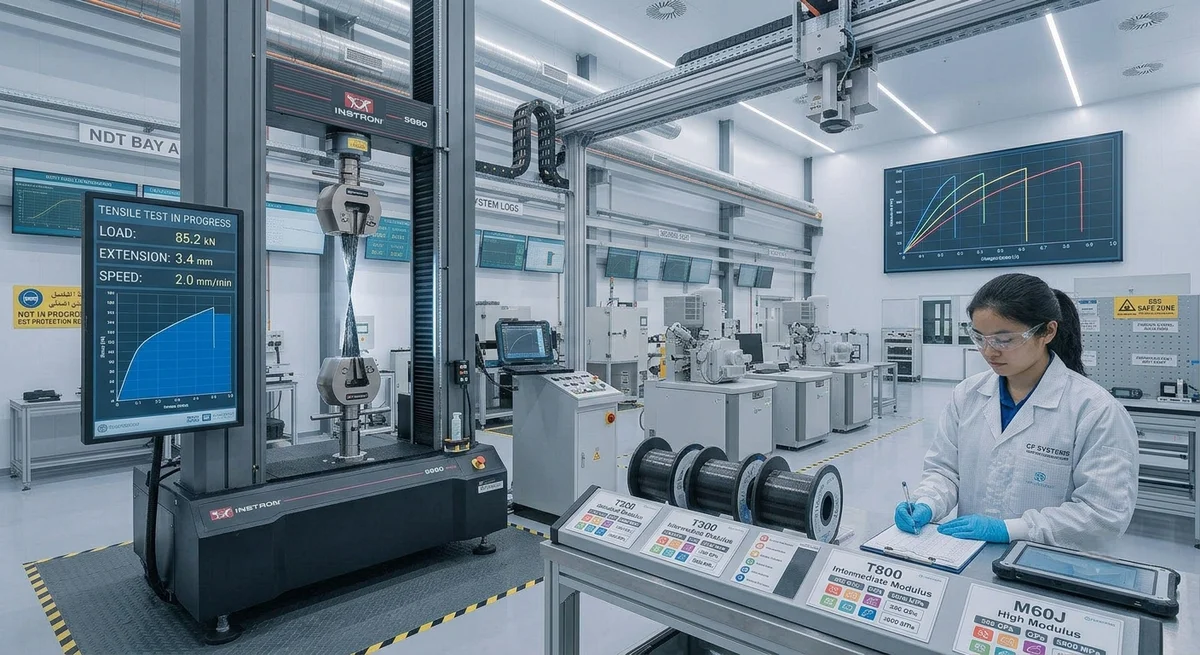
拉伸模量和拉伸强度是碳纤维规格中最关键的两个力学性能指标,但刚接触复合材料的工程师经常混淆它们。本技术指南解释了标准模量、中模量和高模量纤维等级的模量与强度之间的基本关系,并为结构应用的材料选择提供实用指导。
When specifying carbon fiber for a structural composite, engineers must navigate a complex trade-off between tensile modulus and tensile strength — two properties that, contrary to intuition, do not correlate linearly. Understanding this relationship is essential for material selection because choosing the wrong fibre grade can lead to overdesigned (and overpriced) laminates or, worse, premature failure in service. This guide provides a systematic framework for matching fibre mechanical properties to application requirements.
Carbon fiber tensile modulus — a measure of stiffness, or resistance to elastic deformation — is determined primarily by the degree of graphitic crystallite orientation along the fibre axis. Higher graphitisation temperatures (1800–3000 °C) during processing produce more aligned carbon layer planes, yielding fibres with moduli exceeding 800 GPa. However, this increased order comes at a cost: the high-temperature treatment reduces the number of structural defects that serve as energy-dissipation sites during fracture, making the fibre more brittle. Consequently, tensile strength — the maximum stress the fibre can withstand before breaking — typically peaks at intermediate modulus levels and declines in ultra-high-modulus grades.
The practical implication is that modulus and strength follow a bell-shaped relationship within the PAN-based carbon fibre family. Standard modulus fibres (220–250 GPa) offer moderate stiffness with high strength (3500–4800 MPa), making them the workhorse for general structural applications. Intermediate modulus fibres (280–350 GPa) achieve the highest strength values — up to 5500–7000 MPa in aerospace-grade fibres like Toray T1100G or HexTow HM63 — because the graphitic structure is sufficiently aligned for stiffness while retaining enough turbostratic disorder for toughness. High modulus fibres (350–600 GPa) show declining strength (2500–4000 MPa) as brittleness increases, while ultra-high-modulus fibres (600–900 GPa) exhibit the lowest strength (1500–2500 MPa) despite extreme stiffness.
For practical engineering, the selection decision hinges on the dominant load condition. Stiffness-critical applications — such as satellite booms, precision instrument frames, or wind turbine blade spars — benefit from high-modulus fibres that minimise deflection under load, even at the expense of strength. Strength-critical applications — pressure vessels, impact-prone automotive structures, or aerospace primary structures — require intermediate-modulus fibres that maximise fracture resistance. Cost-sensitive applications typically default to standard-modulus fibres, which offer the best balance of mechanical performance and price (USD 20–40/kg versus USD 80–200/kg for high-modulus grades).
| Fiber Grade | Tensile Modulus (GPa) | Tensile Strength (MPa) | Elongation at Break (%) | Typical Cost (USD/kg) | Primary Applications |
| --- | --- | --- | --- | --- | --- |
| Standard Modulus (e.g., T300, AS4) | 230 | 3,530 | 1.5 | 20–35 | General structural, automotive, sports equipment |
| Intermediate Modulus (e.g., T800, IMT) | 294 | 5,490 | 1.9 | 50–80 | Aerospace primary structure, pressure vessels |
| High Modulus (e.g., M40J, HR40) | 377 | 4,410 | 1.2 | 80–120 | Satellite structures, precision instruments |
| Ultra-High Modulus (e.g., M60J, YS-90A) | 588 | 3,920 | 0.7 | 150–200 | Space booms, optical benches, thermal management |
| Pitch-Based (e.g., K13D, YSH-70A) | 790 | 2,600 | 0.3 | 300–600 | Heat spreaders, thermal management, space radiators |
- Modulus is dictated by graphitisation temperature — higher temperature → higher crystallite alignment → higher stiffness, but also higher brittleness and lower strength
- Strength peaks in intermediate-modulus fibres (280–350 GPa), where the structure balances crystallite alignment with retained turbostratic disorder for toughness
- The elongation at break decreases consistently with increasing modulus — from 1.5–2.0% for standard-modulus fibres to 0.3–0.5% for ultra-high-modulus grades — affecting drapability and design strain limits
- Cost scales nonlinearly with modulus: high-modulus fibres cost 3–10× more than standard grades due to extended high-temperature processing and lower production yields
- Hybrid laminates combining standard and high-modulus fibres in different plies can optimise the stiffness/cost trade-off by placing stiffer fibres in outer plies where bending moment is highest
### FAQ
**Q: Why does carbon fiber strength decrease at very high modulus levels?**
The high graphitisation temperatures (2500–3000 °C) required to achieve extreme crystallite alignment also anneal out microstructural defects that act as crack-arresting sites. With fewer energy-dissipation mechanisms, cracks propagate more easily, reducing the ultimate tensile strength. This is a fundamental materials science constraint, not a manufacturing limitation.
**Q: Can I mix different modulus fibres in the same laminate?**
Yes — this is called a hybrid laminate and is widely used to optimise performance. However, careful attention must be paid to strain compatibility. High-modulus fibres fail at lower strains (0.3–0.7%) than standard-modulus fibres (1.5–2.0%). If they are mixed in the same ply or orientation, the high-modulus fibres may fracture first, creating stress concentrations that trigger premature failure of the standard-modulus fibres.
**Q: What is the most commonly used carbon fibre grade for aerospace?**
Intermediate-modulus fibres dominate aerospace primary structures. Toray T800S (294 GPa modulus, 5,880 MPa strength) and Hexcel IM7 (276 GPa, 5,170 MPa) are the most widely specified grades for commercial aircraft, used in Boeing 787 and Airbus A350 wing and fuselage structures.
**Q: How should I select fibre grade for a pressure vessel?**
Pressure vessels (Type III and Type IV) are strength-critical rather than stiffness-critical. Choose intermediate-modulus fibres with the highest tensile strength — typically 5500–7000 MPa — as the burst pressure is limited by fibre fracture. T700S (230 GPa, 4900 MPa) is a cost-effective choice for industrial CNG tanks, while T1100G (324 GPa, 7000 MPa) is preferred for high-performance hydrogen storage.
**Q: What testing standard should I use to verify fibre mechanical properties?**
The most widely accepted standards are ASTM D4018 (tensile properties of continuous fibre) and ISO 10618 (carbon fibre — determination of tensile properties of resin-impregnated yarn). Always verify that supplier data sheets reference these standards, as non-standard test methods can produce significantly different results.
The relationship between tensile modulus and tensile strength in carbon fibre is a classic engineering trade-off governed by the degree of graphitic crystallinity. No single fibre grade excels in both properties simultaneously. Standard-modulus fibres offer the best value for general use, intermediate-modulus fibres deliver peak strength for demanding structural roles, and high/ultra-high-modulus fibres provide unmatched stiffness for precision applications. Understanding where your application falls on the modulus–strength curve is the first and most important step in material selection. YongXian CarbonFiber supplies a full range of PAN-based and pitch-based carbon fibres spanning 230–900 GPa modulus, with full mechanical test data traceable to ASTM D4018 and ISO 10618 standards.
碳纤维模量拉伸强度材料选择PAN纤维等级高模量碳纤维
所属专题
相关文章
对我们的产品感兴趣?
联系我们的团队获取 competitive 报价和技术规格。
获取报价相关产品
plates
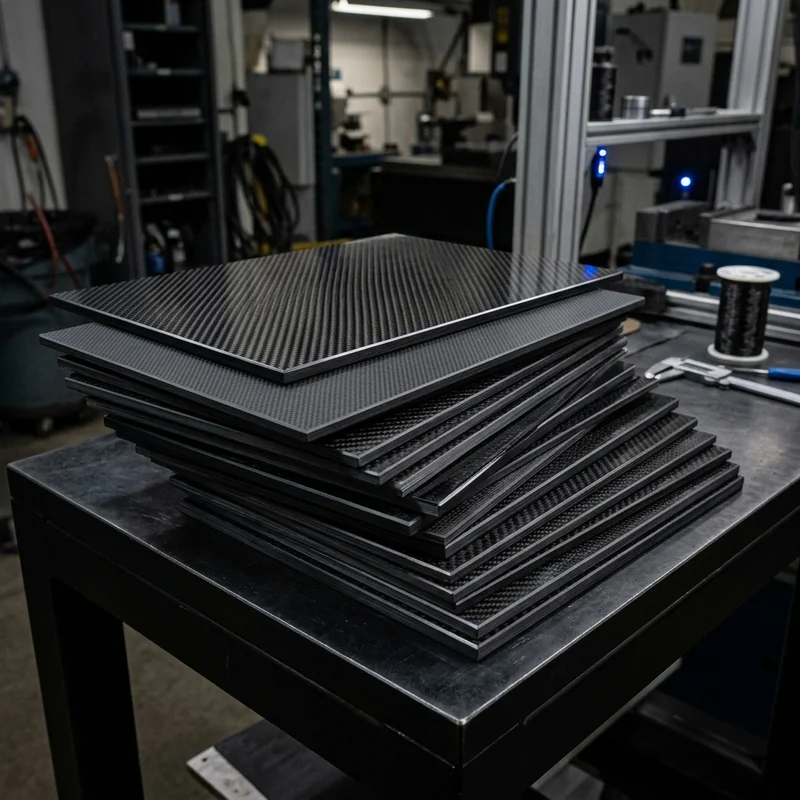
碳纤维标准板材-3k条纹
轻量化超高刚性标准板材,适用于无人机机身、机器人外壳、外立面及结构性应用。
查看详情

plates
碳纤维板 — 3K斜纹 T700 1.5mm
1.5mm薄型碳纤维板,3K斜纹编织表面。轻质高刚,常用于外壳、面板、无人机机身和需要高级外观的应用。
查看详情

tubes
方管碳纤维管 — 3K斜纹 T700
3K斜纹编织的方形碳纤维管,具备优异抗扭强度。适用于结构框架、桁架和支撑柱,矩形截面提供设计灵活性。
查看详情

plates
碳纤维板 — 3K斜纹 T700 3.0mm
3.0mm中厚碳纤维板,承重能力显著提高,同时保持3K斜纹外观。适用于结构支架、加固板和承重面板。
查看详情
plates
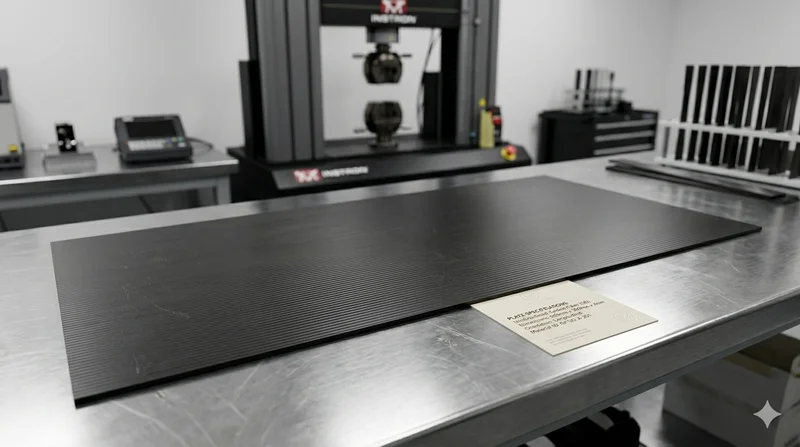
碳纤维板 — UD单向 T700
单向碳纤维板,所有纤维沿单一方向排列,沿纤维轴向强度最大。适用于结构加固、夹板等负载方向可预测的应用。
查看详情