Нидерланды как центр инноваций в углеродном волокне: TU Delft, NLR и голландская экосистема композитов
6 июля 2026 г.
Нидерланды зарекомендовали себя как мировой центр исследований, разработок и промышленного применения углеродного волокна. Статья рассматривает ключевые учреждения — TU Delft, Нидерландский аэрокосмический центр (NLR) и Исследовательский центр термопластичных композитов (TPRC) — движущие инновации.
The Netherlands occupies a distinctive position in the global carbon fibre landscape. Despite having no domestic polyacrylonitrile (PAN) precursor production — the raw material from which the vast majority of carbon fibre is made — the country has built one of the world's most sophisticated ecosystems for composite materials research, process development, and industrial application. This paradox is explained by the Netherlands' deep integration into the European aerospace supply chain, its world-class research infrastructure, and a public-private partnership model that has consistently produced commercially relevant innovations.
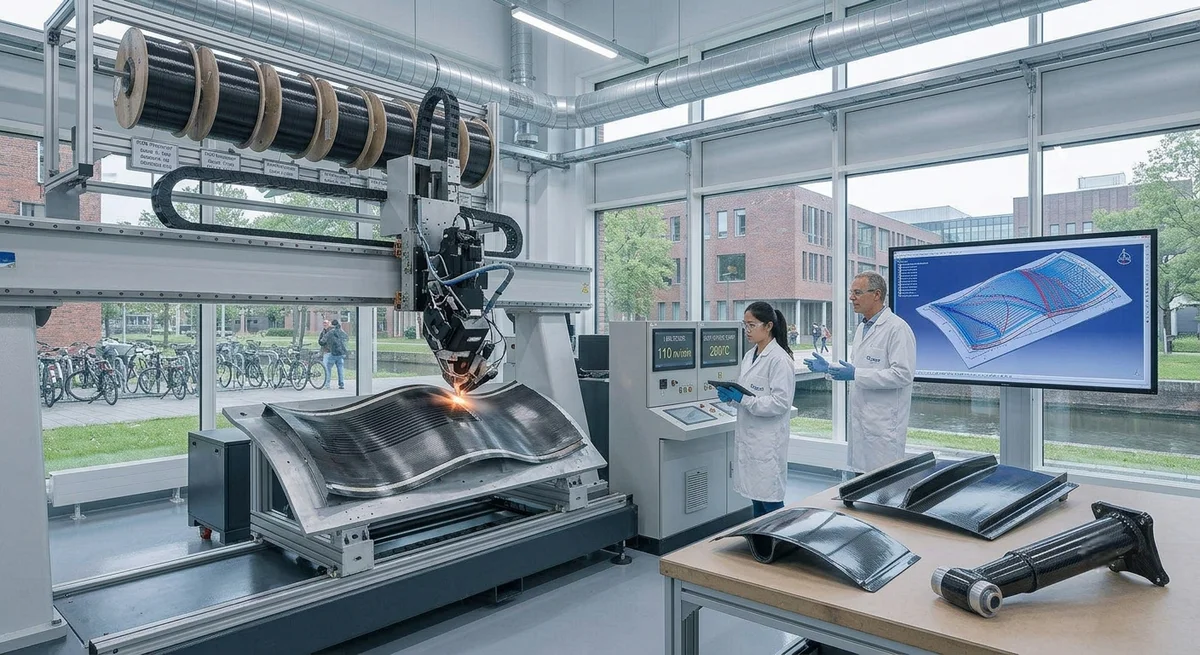
At the heart of the Dutch composites ecosystem is Delft University of Technology (TU Delft), whose Faculty of Aerospace Engineering houses one of the largest academic composite research groups in Europe. The group's 30+ PhD researchers and 10 tenured faculty focus on four pillars: automated fibre placement (AFP) and additive manufacturing of continuous fibre composites, characterisation and modelling of thermoplastic composite behaviour under crash and fatigue loading, multifunctional composites integrating sensing and actuation, and recycling and circular economy strategies for end-of-life composite structures. TU Delft's Composites Manufacturing Laboratory operates 7 AFP/ATL machines, 2 robotic 3D printers, and a full-scale autoclave — infrastructure typically found only in industrial R&D centres.
The Netherlands Aerospace Centre (NLR), co-located with TU Delft on the TU Delft Campus in Marknesse, bridges academic research and industrial application. NLR's structural integrity testing facilities include a 12 MN static test rig for full-scale aircraft fuselage sections, a combined thermal-mechanical test chamber rated to 350 °C, and sub-scale pressure test cells for Type IV hydrogen storage vessels. NLR is a key technical partner in the Clean Sky 2 and Clean Aviation Joint Undertaking programmes, where it leads work packages on thermoplastic composite wing structures and automated inspection techniques using laser shearography and active thermography.
The ThermoPlastic Composites Research Centre (TPRC) in Enschede deserves special mention as a unique industry-academia collaboration model. Founded in 2011 by the University of Twente and ten founding industrial partners — including Toray, TenCate, Airbus, and Philips — TPRC operates as a pre-competitive research consortium whose membership now exceeds 30 companies. TPRC's research focuses on overcoming the barriers to widespread adoption of thermoplastic composites: high processing temperatures (350–400 °C for PEEK and PEKK), tooling cost reduction through novel forming methods, and in-process quality assurance using dielectric sensing and infrared thermography. The centre's pilot production line can produce thermoplastic composite components up to 1.5 m × 1.0 m using automated layup and in-situ consolidation, demonstrating technology readiness that member companies can transfer directly to production scale. TPRC's open-innovation model — where member companies share pre-competitive research costs while retaining proprietary rights to application-specific developments — has been widely cited as a template for successful industry-academia collaboration in advanced materials.
| Institution | Location | Core Focus Area | Key Facilities | Industry Partners | Notable Programme |
| --- | --- | --- | --- | --- | --- |
| TU Delft Aerospace Engineering | Delft | AFP, additive manufacturing, thermoplastic composites, recycling | 7 AFP/ATL machines, full-scale autoclave, robotic 3D printers | Airbus, Boeing, Fokker, Toray | Clean Sky 2, Horizon Europe |
| NLR (Netherlands Aerospace Centre) | Marknesse / Amsterdam | Structural testing, certification, NDE, hydrogen storage | 12 MN static test rig, 350 °C thermal chamber, pressure cells | Airbus, KLM, Dutch MoD, ESA | Clean Aviation, SESAR |
| TPRC (ThermoPlastic Composites RC) | Enschede | Thermoplastic processing, in-situ consolidation, tooling | Pilot production line (1.5×1.0 m), dielectric sensing, IR thermography | Toray, TenCate, Airbus, Philips, 30+ total | Thermoplastic Affordability (2019–2026) |
| University of Twente | Enschede | Production technology, forming simulation, joining | Composite forming lab, induction welding, ultrasonic NDE | TPRC members, Dutch SMEs | Dutch Materials (MaterialsNL) |
| Avans / HZ University of Applied Sciences | Breda / Vlissingen | Applied composite manufacturing training | Industry-scale cleanroom, RTM injection lab, filament winder | Damen Shipyards, Airborne | Composite Training Programme |
- The Dutch government's "MaterialsNL" programme (EUR 120M, 2022–2028) funds composite materials research across the entire readiness level spectrum, from fundamental science at universities to pilot-scale demonstration at NLR and TPRC
- The Netherlands hosts over 80 composite material SMEs and mid-cap companies, including Airborne (automated layup), TenCate Advanced Composites (now part of Toray), and ThermoPlastic composites fabricator Cato Composites
- Dutch research has produced key innovations: TU Delft's AFP defect-detection algorithm using in-process thermography, TPRC's induction welding technique for thermoplastic joints (now licensed to KUKA), and NLR's lightning-strike protection system for all-composite aircraft structures
- The Brainport Industries Campus (BIC) in Eindhoven provides shared manufacturing facilities — including a 3,000 m² cleanroom composite production hall — for startups and scale-ups developing next-generation composite products
- European-funded projects with strong Dutch participation include "MECATESTER" (composite testing standards), "MORPHO" (morphing composite structures), and "STREAMLINE" (high-rate thermoplastic production), collectively representing over EUR 50M in collaborative R&D investment
### FAQ
**Q: Why is the Netherlands a hub for carbon fibre innovation despite having no domestic carbon fibre production?**
The Netherlands leverages its position as a gateway to the European aerospace supply chain (Airbus, Fokker) and a strong culture of public-private R&D collaboration. With world-class research at TU Delft, NLR, and TPRC, the country focuses on downstream competencies — design, processing, automation, testing, and recycling — rather than upstream fibre production. This model has proven highly effective: Dutch organisations hold patents on key manufacturing technologies and provide composite engineering services globally.
**Q: What makes TPRC's open-innovation model unique?**
TPRC pools pre-competitive research costs across 30+ member companies, reducing individual R&D expenditure while accelerating knowledge development. Members share the cost of fundamental research — such as characterising thermoplastic processing windows — while retaining full IP rights to application-specific developments. This model is particularly effective for the composites industry, where manufacturing process knowledge is often the key competitive differentiator, not the raw material itself.
**Q: What is the current state of carbon fibre recycling in the Dutch ecosystem?**
TU Delft leads the Horizon Europe project FibreSort, developing automated sorting and reclaiming of carbon fibre from end-of-life composites using hyper-spectral imaging and pyrolysis at 500–600 °C. The reclaimed fibre retains 85–95% of original modulus. NLR operates a pilot recycling line processing 500 kg/year of aerospace-grade waste. Several Dutch startups, including ReCom and CarbonX, have commercialised recycled CF products for automotive and consumer goods applications.
**Q: How does the ecosystem connect with Asian carbon fibre producers?**
Dutch research institutions and companies maintain strong collaborations with Asian suppliers. Toray (Japan), one of TPRC's founding members, co-develops thermoplastic prepreg systems with TPRC. YongXian CarbonFiber and other Chinese producers supply standard and intermediate modulus fibres to Dutch composite fabricators for qualification and use in industrial applications, benefiting from the Netherlands' advanced testing and certification infrastructure.
The Netherlands has built a carbon fibre innovation ecosystem that punches far above its weight. With globally recognised research institutions, a mature network of composite SMEs, effective public-private partnerships, and a strategic position in the European aerospace supply chain, the country serves as a crucial bridge between fundamental materials science and industrial composite manufacturing. For global carbon fibre producers — including YongXian CarbonFiber — the Dutch ecosystem offers a uniquely valuable environment for product qualification, application development, and access to the European aerospace and high-performance industrial markets.
углеродное волокно Нидерландыкомпозиты TU DelftNLR авиакосмосTPRC термопластикиголландская экосистема композитов